





Solutions
Geotechnical analysis, from slope to tunnel
Slope stability, foundation design, retaining walls, tunnel linings and pavements — numerical rigor for critical infrastructure, from 2D limit analysis to 3D FEM.
Start here
Find your job on this list.
Slope Stability & Excavation Analysis
Factors of safety for slopes, embankments and staged excavations — limit equilibrium, strength reduction FEM and rigorous bound methods.
Geotechnical Monitoring & Back-Analysis
Field monitoring data integrated with numerical models for parameter back-analysis on active construction sites.
Pavement & Marine Infrastructure
Flexible and rigid pavements with multi-layer analysis, plus floating structure stability and wind-generated wave loads for marine projects.
The tools
Products for Geotechnical, Foundation & Infrastructure Software
Numerical engines for the hard problems, task programs for the everyday ones, pavement and marine tools alongside.
Numerical analysis engines

PLAXIS 2D
2D finite element analysis for deformation, stability and groundwater flow — excavations, embankments, tunnels, consolidation.

PLAXIS 3D
Full 3D finite element analysis for soil-structure interaction — pile groups, deep excavations, complex geometry.

OPTUM G2
2D limit analysis with rigorous upper and lower bounds — slope stability and bearing capacity.

OPTUM G3
3D limit analysis and FEA — stability, deformation and consolidation for complex foundations and slopes.

CESAR LCPC
General-purpose FEA for tunnelling and staged construction — coupling mechanics, groundwater flow, heat and dynamics.
Task-based design programs

GEO5
Task-based programs for retaining walls, foundations, slopes and settlement — submittal-grade reports to your code.

C-TUNNEL
Tunnel lining pre-design by convergence-confinement — exports to CESAR 2D for detailed analysis.
Pavement and marine
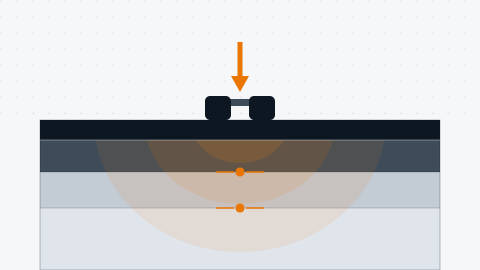
ALIZE LCPC
Mechanistic-empirical pavement design — fatigue and rutting checks per the French LCPC method.

cgFLOAT
Dynamic analysis of floating marinas, breakwaters and pontoon bridges — wave-induced motions and mooring loads.

cgWindWaves
Wind-generated wave computation — significant height, period and spectra for coastal design.
Answered
Questions engineers ask us.
2D finite-element analysis of embankments
PLAXIS 2D builds the embankment in stages, lift by lift. Consolidation analysis tracks pore pressure and settlement between lifts. A Safety phase runs phi-c reduction for the factor of safety. The governing failure mechanism plots so you can see what fails.
3D soil-structure interaction for pile groups
PLAXIS 3D models the whole group: piles, raft and soil in one mesh. Embedded beam and interface elements carry the pile-soil contact, slip and gap included. Pile-soil-pile interaction and group settlement come straight from the analysis. The load split between piles and raft reads from the results.
Slope stability by limit analysis (2D)
OPTUM G2 computes an upper and a lower bound on collapse. The true factor of safety provably sits between them. Strength Reduction FELA resolves slope safety factors in seconds. Adaptive meshing packs elements into the failure zone on its own.
Bearing capacity with seepage and water table
Bearing capacity computes directly as a one-step limit load. Upper and lower bounds bracket the true value from both sides. Seepage runs on the same model, steady-state or transient, saturated or unsaturated. Limit, seepage and consolidation analysis all share that one 2D model.
3D foundation and excavation limit analysis
OPTUM G3 runs limit analysis on a full 3D solid model. Bearing capacity and collapse loads come with rigorous upper and lower bounds. Excavation stages model by activating and deactivating regions of the solid. Adaptive meshing refines the failure zone without manual mesh studies.
Retaining wall design and settlement analysis
GEO5 gives each task its own program. The wall programs check earth pressures, sliding, overturning, bearing and the RC stem. Settlement runs in its own module on the same shared soil data. Every result prints as a submittal-grade report to your chosen code.
Pile group design and verification
The Pile and Pile Group programs cover axial and lateral design. Bored, driven and CFA pile types run, with negative skin friction included. Pile CPT designs straight from cone penetration data. Verification follows Eurocode 7, LRFD or your local standard, with full reports.
3D finite-element analysis for tunnels and soils
CESAR 3D meshes the ground and structure into one FE model. Staged construction runs unlimited excavation, embanking and tunnelling stages. Soil behaviour picks from Mohr-Coulomb, Hardening Soil, Cam-Clay or Hoek-Brown. One solver couples mechanics, groundwater flow, heat and dynamics.
Further reading
Written for this work.
Road Pavement Design: Traffic, Subgrade and Layer Thickness
How traffic loads, subgrade strength, materials and climate set pavement layers and thickness, plus mechanistic-empirical design and rehabilitation.
Consolidation Analysis: Predicting Soil Settlement Over Time
Predict how far a soil layer settles and how long it takes — Terzaghi's theory, oedometer testing, pre-consolidation pressure and finite element analysis.
Pile Foundation Construction: 4 Pile Types, 6 Build Steps
Timber, concrete, steel and composite piles compared, the six-step sequence from site preparation to pile cap, and how skin friction and end bearing work.
Get started
Ready to put numerical rigor behind your next project?
Tell us the job. We will name the tool that does it and show you on your own model.
Book a demo