





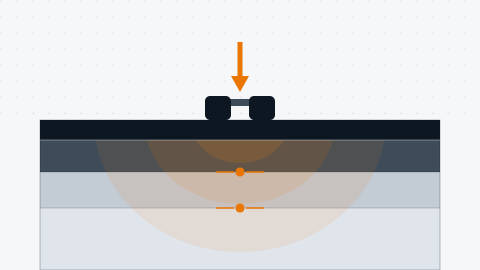
New road and highway pavement design
Structural design of new flexible, thick-bituminous, semi-rigid, and rigid concrete pavements for roads and highways using the French design guide and catalogue.

Mechanistic-Empirical Pavement Design per French LCPC Method
Road Pavement Design Software — Mechanistic-empirical structural analysis and design for flexible and rigid pavements.
Overview
ALIZE-LCPC is a mechanistic-empirical pavement design program from Université Gustave Eiffel (formerly IFSTTAR/LCPC), distributed by itech and supplied in India and South Asia by RAM CADDSYS. It applies Burmister multi-layer elastic theory to compute stresses/strains/deflections through a layered pavement, then checks them against French rational-method fatigue and rutting criteria. Four modules cover new roads, strengthening and rehabilitation, airfields and port platforms.
Content verified against the vendor's official material — Last updated 18 July 2026
Applications
The day-to-day engineering work ALIZE LCPC is used for.
Structural design of new flexible, thick-bituminous, semi-rigid, and rigid concrete pavements for roads and highways using the French design guide and catalogue.
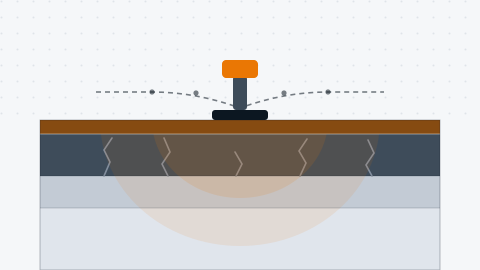
Evaluating in-service pavements — residual life, distress diagnosis, and back-calculated layer moduli from FWD or Benkelman beam deflection surveys — then designing the overlay or strengthening solution.
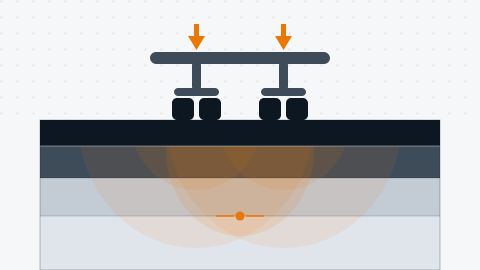
Design of runway, taxiway, and apron pavements under aircraft landing-gear loading using the 2013 STAC-DGAC/IFSTTAR rational airfield method, with an aircraft database and daily-traffic assistant.
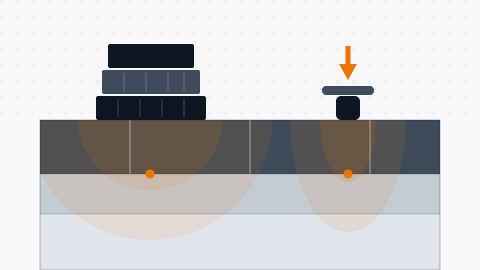
Dimensioning heavy-duty container-handling yards and logistics platforms for extreme static and dynamic loads from stacked containers and handling equipment, per RGRA n°916.
Design Codes
NF P98-086 (2019)
Structural design of pavements and foundations
Guide technique de dimensionnement des chaussées
SETRA/LCPC, 1994
Catalogue des structures types de chaussées neuves
1998
Guide des Variantes — frost-thaw (gel-dégel) verification
2003
STAC-DGAC / IFSTTAR airfield pavement design guide
2013
RGRA article n°916 (2013)
port and logistics platforms
Compare
ALIZE-LCPC handles rational layered-elastic pavement design, while CESAR-LCPC extends into full finite element analysis when a pavement problem outgrows layered-elastic assumptions.
| Criterion |  |  |
|---|---|---|
| Method | ALIZE-LCPCBurmister multi-layer linear-elastic theory | CESAR-LCPCGeneral-purpose finite element analysis (2D and 3D) |
| Best for | Fast, code-compliant pavement thickness design and rehabilitation using the French rational method | Pavement problems with complex geometry, non-linear materials, 3D slabs, or thermal loading beyond layered-elastic assumptions |
| Scope | Dedicated to pavement structures — roads, airfields, port/logistics platforms, and rehabilitation | Broader civil and geotechnical FEA — tunnels, excavations, foundations, slopes, and pavements |
| Design basis | Strength: Verifies against NF P98-086, the French pavement catalogue, and STAC-DGAC/RGRA n°916 admissible-strain criteria | Simulation and analysis platform; geotechnical and pavement verification is performed by the engineer from the FE results |
Many practices run ALIZE for everyday layered-elastic pavement design and reach for CESAR only when a project needs full finite element analysis.
Talk to our team about ALIZE LCPC training and onboarding, or browse the live and self-paced courses on RAM CADDSYS Campus.
Get started
Road Pavement Design Software — Mechanistic-empirical structural analysis and design for flexible and rigid pavements. Supplied in India and South Asia by RAM CADDSYS — licensing, training and engineering support from one team.
Chennai, IN
Mon–Sat, 9–6 IST
Singapore, SG
Mon–Fri, 9–6 SGT
Dubai, AE
Mon–Fri, 9–6 GST
Keep Exploring
Most teams run ALIZE LCPC alongside one of these — same engineering rigour, same support desk, one partner.
View all productsFrom the same LCPC school — general-purpose FEA when the pavement problem needs full modelling.

Advanced geotechnical FEA for the ground beneath the pavement — settlement, stability, groundwater.

Routine geotechnical design around the pavement — foundations, walls and stability, fast.
