





Steel structure design focuses on creating the metal framework that forms one of the main parts of a building structure. Steel structures are widely used because of advantages such as being lightweight, having excellent overall rigidity, and high strength.
In this article, we look at the three methods used for steel structure design.
There are three methods that are commonly used for designing steel structures:
- Simple Design of Steel Structure
- Continuous Design of Steel Structure
- Semi-Continuous Design of Steel Structure
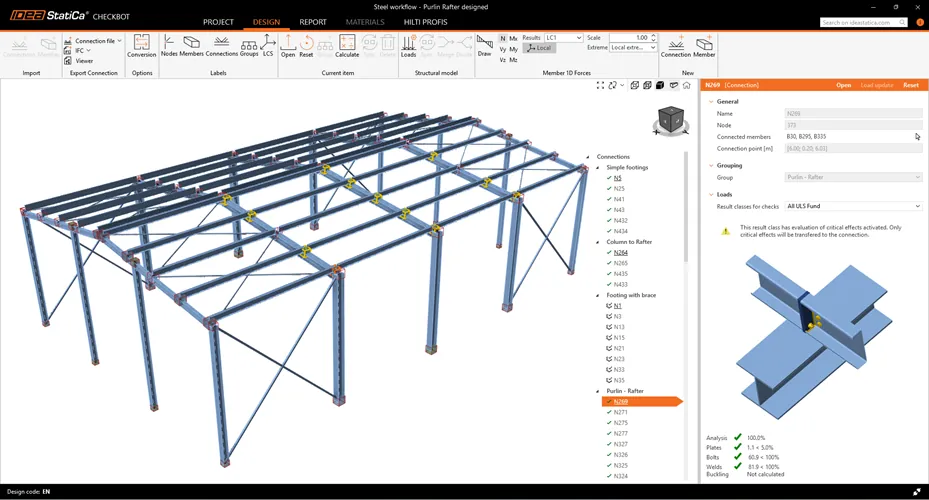
1. Simple Design of Steel Structure
Simple design is the traditional approach commonly used for designing steel structures.
In this method, it is assumed that no moment is transferred from one connected member to another.
Resistance to lateral loads and sway is usually ensured by providing bracing or, in multi-storey buildings, by concrete cores.
The designer must recognise and ensure that every connection detail is such that no moments develop that would adversely affect the performance of the structure.
To meet the specifications and the main principle of this design approach, the designer should refer to the standard joint connections used in a simple steel structure.
2. Continuous Design of Steel Structure
In continuous design, the joints are assumed to be rigid and to transfer moments between the members.
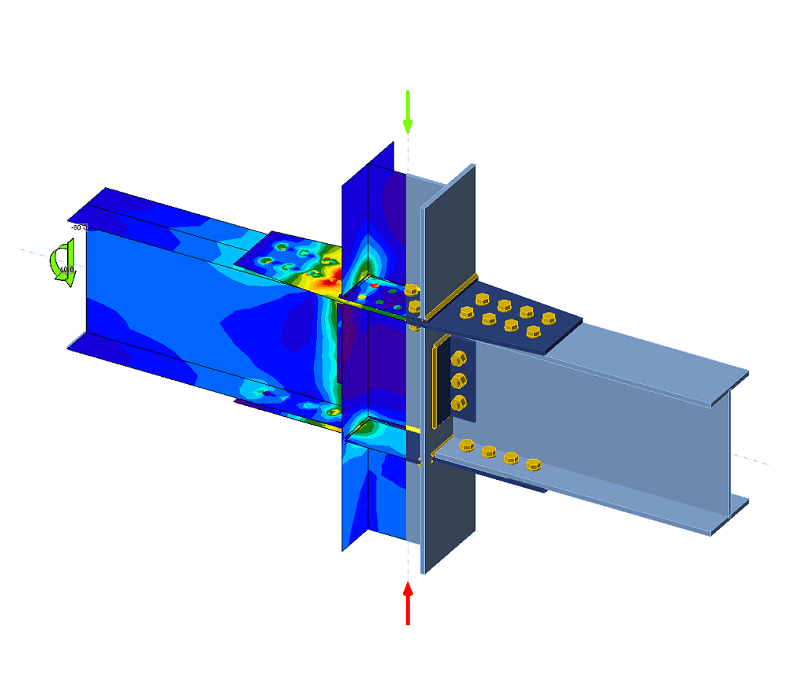
Continuous design of a steel structure is more complex than simple design, so it is essential to use software to design this type of structure.
Realistic combinations of pattern loading must be considered when designing continuous frames. The connections between members must have different characteristics depending on whether the frame design method is elastic or plastic.
In elastic design, the joints must possess sufficient rotational stiffness so that the distribution of forces and moments around the frame is not significantly different from the values calculated.
The benefit of continuous steel structure design is that it performs better in earthquakes, so it is recommended in earthquake-prone areas. Beams used in this type of structure are less deep than those used in simple steel frames.
3. Semi-Continuous Design of Steel Structure
Semi-continuous design reduces the depth and weight of the beam. This design approach is an economical structural design that minimises drafting and fabrication charges.
This framing is used with the wind moment method for unbraced or foundationless frames — the process by which the design frame resists sideways or lateral wind loads. For supporting frames, the actual joint behaviour is considered in this process by reducing the lateral load applied to the beam and its deflection.
| Design Method | Key Characteristic | Joint Behavior | Benefit |
|---|---|---|---|
| Simple Design | Traditional approach | No moment transferred | Standard sway resistance |
| Continuous Design | More complex design | Rigid joints transfer moments | Better performance in earthquakes |
| Semi-Continuous | Economical design | Actual joint behavior considered | Reduced beam depth and weight |
Modelling all three methods to code
Continuous and semi-continuous designs, in particular, depend on realistic joint behaviour and pattern loading that are difficult to track by hand. Whichever method governs the frame, the individual connections still have to be modelled and code-checked for the moments, shears, and axial forces they carry, verifying that the actual joint stiffness matches what the global analysis assumed.
The tool for this

Code-check any steel connection to AISC & Eurocode.
Model welded, bolted and moment connections on the real geometry with CBFEM — clear pass/fail results and a full report in minutes.
FAQs
What are the main methods for steel structure design?
There are three methods usually used: Simple Design, Continuous Design, and Semi-Continuous Design.
What is the Simple Design of steel structure?
This is a traditional approach where it is assumed that no moment is transferred from one connected member to another.
How does Continuous Design of steel structure work?
In Continuous Design, joints are assumed to be rigid and transfer moments between members. This method is more complex than Simple Design.
Why is Continuous Design recommended for earthquake-prone areas?
Continuous steel structures perform better in earthquakes because the joints possess sufficient rotational stiffness.
What is the Semi-Continuous Design of steel structure?
This is an economical design method that reduces the depth of the beam and its weight, minimizing drafting and fabrication charges.
How are lateral loads handled in Simple Design?
Resistance to lateral loads and sway is ensured by providing bracing or, in multi-story buildings, by concrete cores.
What is the difference in beam depth between the methods?
Beams used in Continuous and Semi-Continuous designs are generally less deep than those used in Simple steel frames.


