





Steel sections are a foundational material in modern construction and engineering projects. From high-rise buildings to bridges, from machinery to industrial equipment, steel sections play a central role in the built environment. This guide covers the types of steel sections, their applications, manufacturing processes, and sustainability considerations.
Understanding Steel Sections
Steel sections, also known as structural steel shapes or profiles, are hot-rolled or cold-formed products made from steel billets or coils. These sections come in various shapes and sizes, each suited to specific structural or engineering purposes.
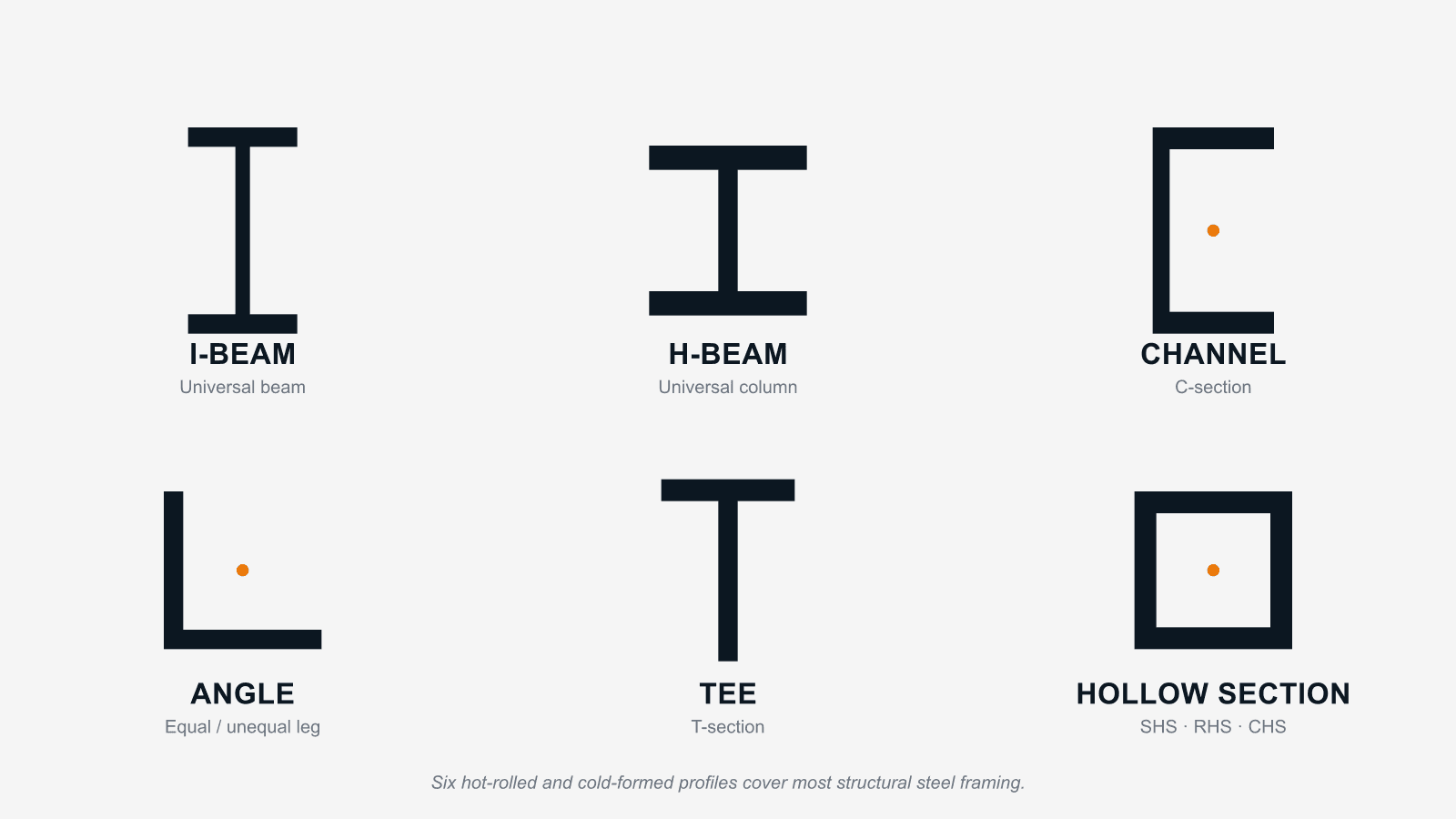
The most common shapes include I-beams (universal beams), H-beams (universal columns), channels, angles, tees, and hollow sections.
Types of Steel Sections
- I-Beams (Universal Beams) — Characterized by their distinctive "I" shape, with wide flanges and a narrow web. Widely used for beams and columns due to their load-bearing capacity and resistance to bending.
- H-Beams (Universal Columns) — A structure similar to I-beams but with thicker flanges and a wider web. Commonly used as columns and supporting structures in building frames and bridges.
- Channels — A C-shaped cross-section, used for framing, support beams, and conveyor tracks.
- Angles — L-shaped sections with equal or unequal legs, used in bracing, frames, and structural components where right angles are required.
- Tees — A T-shaped cross-section, often used for connecting and supporting structural members.
- Hollow Sections — Square, rectangular, and circular profiles offering high strength-to-weight ratios, used in building frames, trusses, and bridges.
| Section Type | Shape Characteristics | Primary Applications |
|---|---|---|
| I-Beams (Universal Beams) | Distinctive "I" shape with wide flanges and a narrow web | Beams and columns requiring high bending resistance |
| H-Beams (Universal Columns) | Similar to I-beams but with thicker flanges and a wider web | Columns and supporting structures in building frames and bridges |
| Channels | C-shaped cross-section | Framing, support beams, and conveyor tracks |
| Angles | L-shaped sections with equal or unequal legs | Bracing, frames, and components requiring right angles |
| Tees | T-shaped cross-section | Connecting and supporting structural members |
| Hollow Sections | Square, rectangular, or circular profiles | Trusses, bridges, and frames requiring high strength-to-weight ratios |
Applications of Steel Sections
These profiles are used across construction and engineering projects worldwide:
- Building Construction — Framing, beams, columns, and other structural elements in residential, commercial, and industrial buildings.
- Bridges and Infrastructure — Carry the spans, and take the fatigue and durability demands bridges impose.
- Machinery and Equipment — Integral to the manufacturing of machinery, equipment, and vehicles due to strength, stiffness, and dimensional stability.
- Offshore Structures — Used for platforms, rigs, and marine structures in oil and gas exploration, offering resistance to harsh environmental conditions.
- Railway Tracks — Universal beams support rails, sleepers, and support structures in rail transportation systems.
Manufacturing Processes
Steel sections are manufactured through hot rolling or cold forming, depending on the required properties and specifications.
- Hot Rolling — Steel billets or blooms are heated above their recrystallization temperature and passed through rolling mills to achieve the desired shape and dimensions. This process produces sections with strong mechanical properties and surface finish.
- Cold Forming — Steel is shaped at room temperature through bending, pressing, or extrusion. Cold-formed sections offer high dimensional accuracy and tight tolerances, suited to precision applications.
Sustainability and Environmental Impact
The steel industry has made progress in environmental performance:
- Recycling — Steel is one of the most recycled materials globally, reducing dependence on virgin raw materials.
- Energy Efficiency — Producers have adopted energy-efficient technologies and processes to reduce consumption and emissions.
- Life Cycle Assessment — LCA studies evaluate the environmental impact of steel sections across their full life cycle, from raw material extraction to disposal.
- Circular Economy — Reuse, remanufacturing, and recycling of steel sections reduce resource depletion and waste.
Future Trends and Innovations
- Advanced High-Strength Steel (AHSS) — Grades offering higher strength, ductility, and formability, enabling lighter designs in automotive, aerospace, and construction applications.
- Digitalization and Automation — AI, machine learning, and robotics are changing steel production, improving efficiency and quality control.
- Sustainable Design Practices — Architects and engineers are incorporating steel sections into designs that prioritize energy efficiency and resource conservation.
- Modular Construction — Techniques using prefabricated steel sections that shorten construction timelines and reduce material waste.
Designing steel section connections
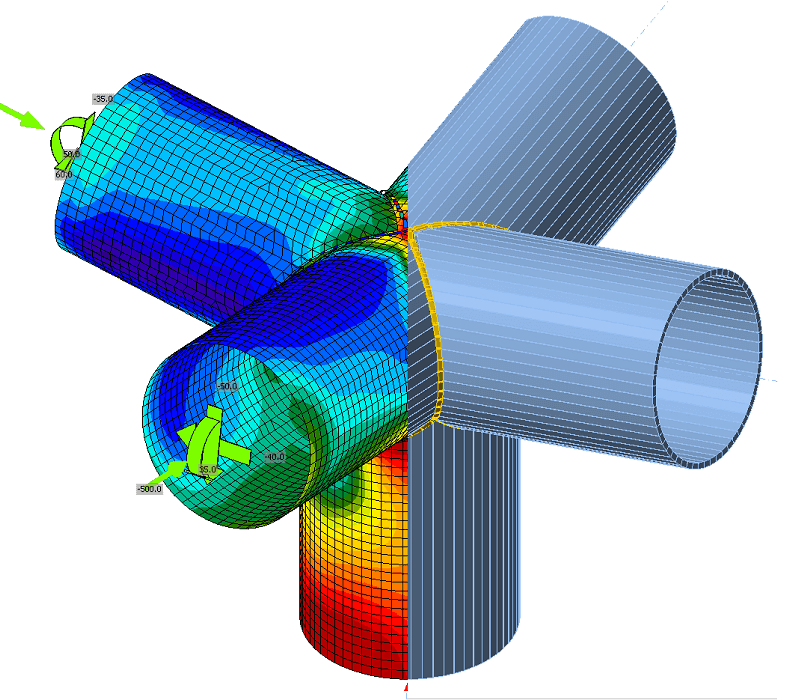
Selecting the right steel section is only the first step — every beam, column, or hollow section eventually meets another member at a connection, and that joint still has to be modelled and code-checked before it governs whether the structural design holds up.
The tool for this

Code-check any steel connection to AISC & Eurocode.
Model welded, bolted and moment connections on the real geometry with CBFEM — clear pass/fail results and a full report in minutes.
FAQs
What are steel sections in construction?
Steel sections, also known as structural steel profiles, are hot-rolled or cold-formed products used as the backbone for buildings, bridges, and infrastructure.
What is the difference between I-beams and H-beams?
I-beams (universal beams) have narrower webs and are used mainly for bending resistance, while H-beams (universal columns) have thicker flanges and are used primarily for columns and support.
How are steel sections manufactured?
Primarily through hot rolling, where billets are heated and passed through rollers, or through cold forming processes such as bending, pressing, or extrusion.
What are the main applications of steel sections?
Building framing, bridges, machinery manufacturing, offshore platforms, and railway tracks.
Are steel sections sustainable?
Steel is highly recyclable, and the industry uses energy-efficient technologies and circular economy principles to minimize waste.
What are hollow sections used for?
Hollow sections (square, rectangular, or circular) offer high strength-to-weight ratios and are used in trusses, bridges, and building frames.


