




A slope fails when the driving forces along a potential slip surface — gravity, water pressure, seismic load — overcome the shear strength of the ground holding it up. The margin between the two is the factor of safety, and estimating it honestly is one of the core jobs of geotechnical engineering.
The stakes are asymmetric: a slope that stands for decades can fail in a single wet season, taking a road, a rail cutting or an embankment dam with it. This guide covers what drives slope failure, the two families of analysis used to compute stability, and the stabilisation measures that actually move the factor of safety.
What makes a slope fail
Four factors dominate, and they usually act together:
- Ground strength. Cohesion and friction angle set the resisting side of the balance. Soft clays, loose fills and weathered rock give the least; their strength can also degrade with time and strain.
- Geometry. Steeper and taller means larger driving stress on any candidate slip surface. Concave breaks, benches and toe excavations change where the critical surface sits.
- Water. The single most common trigger. Rising pore pressure reduces effective stress, which directly cuts the frictional strength of the soil. Most slope failures happen during or after heavy rainfall.
- Loads and disturbance. Surcharge at the crest, excavation at the toe, and seismic shaking all push the balance the wrong way.
The two families of analysis
Limit equilibrium is the classical method: assume a slip surface (usually circular), divide the sliding mass into slices, and balance driving against resisting moments. Methods such as Bishop, Janbu and Morgenstern–Price differ in the assumptions between the slices. It is fast and well-calibrated by decades of practice — but the answer is only as good as the assumed surface, and it says nothing about deformations.
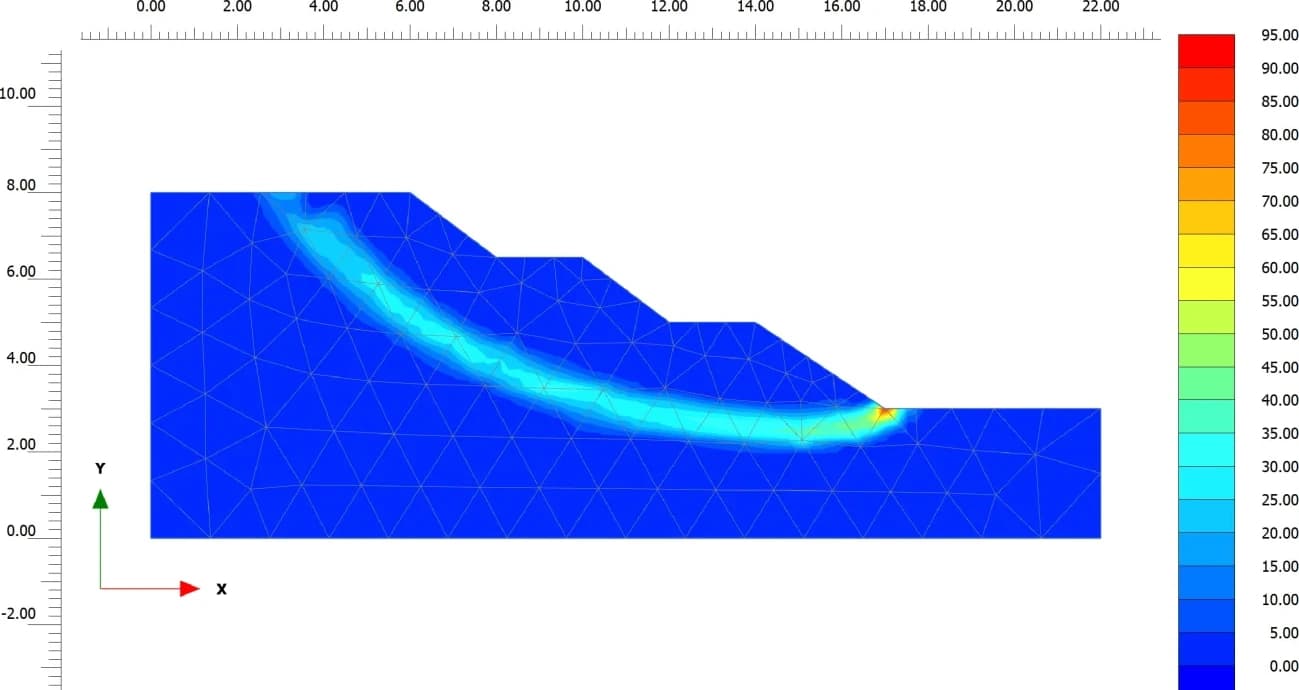
Finite element analysis takes the other route: model the slope's actual stratigraphy, groundwater and staging, and reduce the soil's strength parameters step by step until the model fails — the strength reduction (phi-c reduction) method. The factor of safety falls out of the analysis, and so does the failure mechanism itself.
| Aspect | Limit equilibrium | Finite element (strength reduction) |
|---|---|---|
| Slip surface | Assumed, then searched | Found by the analysis |
| Pore pressures | Applied as input | Coupled flow and consolidation possible |
| Deformations | Not computed | Full displacement field |
| Staged construction | Approximate | Modelled stage by stage |
| Complex stratigraphy | Awkward | Natural |
Reading the factor of safety
Design codes and practice set the acceptance threshold by consequence: commonly around 1.3 for temporary works and 1.5 for permanent slopes above infrastructure. Two numbers matter beyond the headline value:
- Where the critical surface is. A shallow skin failure and a deep-seated rotational failure demand entirely different fixes.
- How the FoS changes with water level. Running the analysis at the design groundwater and at a raised, storm-event level shows how close the slope sits to its trigger.

Stabilisation measures that move the number
- Drainage first. Because water is the usual trigger, lowering pore pressure is the cheapest FoS gain available: surface drains, horizontal drains into the slope, trench drains at the toe.
- Regrade. Flatten the slope or add a toe berm — direct geometry fixes that reduce driving moment.
- Retain. Soil nails, anchors, and retaining structures add resisting force where geometry cannot change.
- Reinforce and protect. Geogrids in engineered fills; vegetation and facing against surface erosion that steepens a slope over time.
Each measure is verified the same way it was analysed: re-run the model with the drain, the berm or the nails in place and confirm the factor of safety lands where the design requires — for staged embankments, at every stage, not just the final one.
The tool for this

Finite-element analysis for soil and rock.
Model deep excavations, slopes, tunnels and foundations in 2D and 3D, with staged construction, consolidation and dynamic analysis.
FAQs
What factor of safety should a slope have?
Typical practice requires about 1.3 for temporary slopes and 1.5 for permanent slopes whose failure would affect people or infrastructure, with project specifications governing. The right threshold depends on consequence of failure, confidence in the ground model, and whether loading is static or seismic.
Why do slopes fail after heavy rain?
Rainfall raises pore water pressure in the slope. Higher pore pressure lowers effective stress, which directly reduces the soil's frictional shear strength — the resisting side of the stability balance drops while the driving weight stays, and the factor of safety falls with it.
What is the strength reduction method?
A finite element technique for slope stability: the soil's strength parameters (cohesion and friction) are progressively reduced until the model can no longer find equilibrium. The reduction factor at failure is the factor of safety, and the concentrated strain band shows the true failure mechanism.
When is limit equilibrium analysis not enough?
When the failure surface is unlikely to be circular — layered ground, thin weak seams, reinforced slopes — or when deformations, staged construction and groundwater changes matter. A finite element analysis models those directly and finds the critical mechanism instead of assuming it.