





Consolidation analysis is a fundamental aspect of geotechnical engineering that deals with understanding the time-dependent settlement behavior of soils under loads. It plays a crucial role in various civil engineering projects such as foundation design, embankment construction, and land reclamation.
The process of consolidation occurs when soil particles rearrange themselves and the excess pore water is drained out due to an applied load. This article provides an overview of consolidation analysis, its significance, and the methods employed in predicting settlement behavior in soils.
What is consolidation analysis?
Consolidation analysis, also known as settlement analysis, is the process of determining the time and magnitude of soil settlement under applied loads. When a load is applied to a soil layer, it compresses the soil particles, resulting in a reduction of void spaces within the soil.
This reduction in void spaces leads to the expulsion of water from the soil through drainage. As the drainage process takes time, settlement in soil is time-dependent. The time required for consolidation depends on the characteristics of the soil and the magnitude of the applied load.
Why consolidation analysis matters
Consolidation analysis directly influences the safety and stability of structures. Predicting settlement behavior helps engineers design foundations, embankments, and other structures in a manner that minimizes long-term settlement and ensures the safety of construction. Ignoring consolidation effects can lead to excessive and uneven settlement, resulting in structural failures or damage.
The consolidation process
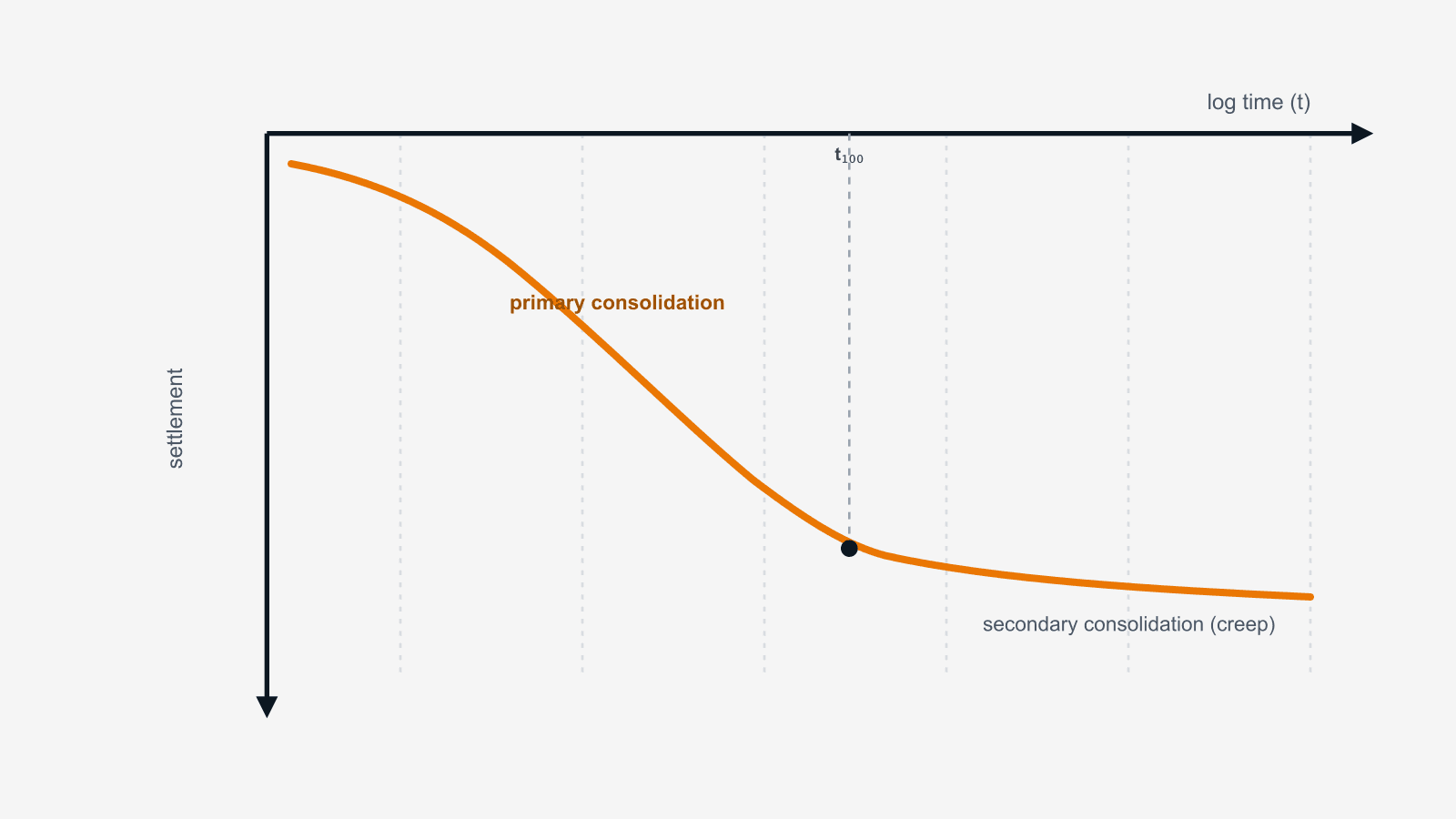
The consolidation process can be divided into primary consolidation and secondary consolidation. Primary consolidation occurs immediately after the application of a load, where soil particles rearrange themselves and expel excess pore water. Secondary consolidation, also known as creep, takes place over a more extended period, during which soil particles continue to adjust gradually. The rate of secondary consolidation is generally slower than primary consolidation but can contribute significantly to total settlement.
Settlement prediction methods
Various methods are used to predict consolidation settlement in soils. One of the most commonly used is Terzaghi's Consolidation Theory, based on the concept of one-dimensional consolidation. The theory considers the consolidation of an infinitely thick soil layer under a uniform load, and provides an expression for calculating settlement over time along with the coefficient of consolidation — a measure of how quickly excess pore water drains from the soil.
The consolidation test
To obtain the necessary data for consolidation analysis, a consolidation test, commonly known as the oedometer test, is performed on a soil sample. During the test, a soil sample is subjected to an incrementally applied load, and the corresponding settlement measurements are recorded at specific time intervals. The test determines the compression characteristics of the soil, including the coefficient of consolidation and the compression index.
Pre-consolidation pressure
Pre-consolidation pressure is another crucial parameter in consolidation analysis. It represents the maximum effective stress the soil has experienced in the past due to geological processes or historical loading. Pre-consolidation pressure helps in understanding the stress history of the soil and its effect on current consolidation behavior.
Consolidation analysis in engineering practice
Consolidation analysis is an essential step in the geotechnical design of engineering projects. Results from consolidation tests are used to develop settlement predictions, which are then incorporated into the foundation design process. Engineers use this data to design foundations that can withstand anticipated settlement without compromising structural integrity.
Factors affecting consolidation
- Soil type — cohesive soils, such as clays, generally have higher compressibility compared to granular soils, such as sands.
- Loading conditions — the magnitude and rate of the applied load significantly impact the consolidation process. Rapidly applied loads may induce greater settlement compared to slowly applied loads.
- Depth of soil layer — deeper soil layers experience a longer duration of consolidation due to the increased drainage path.
- Permeability of soil — highly permeable soils drain excess pore water more quickly, resulting in faster consolidation.
Mitigating settlement issues
- Pre-loading — applying an additional load on the soil before constructing the actual structure, to accelerate consolidation and reduce future settlement.
- Soil improvement — methods such as compaction, vertical drains, and soil stabilization reduce settlement and increase soil bearing capacity.
- Proper foundation design — incorporating consolidation analysis results into the foundation design process ensures the structure is built to withstand anticipated settlement without compromising stability.
Consolidation analysis is a vital aspect of geotechnical engineering, directly supporting the safety and stability of civil engineering projects. Understanding the time-dependent settlement behavior of soils under load helps engineers design appropriate foundations and mitigate settlement-related issues across the project lifecycle.
Modelling consolidation with finite element software
Terzaghi's closed-form theory works well for a single, uniform soil layer, but layered profiles, staged construction, and vertical drains call for numerical modelling that couples pore pressure dissipation with deformation through each construction phase — a job PLAXIS handles directly as a purpose-built geotechnical finite element tool.
OPTUM G3 complements that workflow on the settlement side: its elastoplastic analysis computes soil deformation under the final applied load with automatic adaptive meshing, giving engineers an independent numerical check on the settlement a foundation or embankment design assumes. RAM CADDSYS implements both as PLAXIS partner in the region, and RAM CADDSYS Campus certified courses include a free software license for engineers looking to build this into their practice.

The tool for this

3D geotechnical finite-element analysis.
Compute bearing capacity by Limit Analysis and settlements by elastoplastic analysis, with automatic adaptive meshing.
FAQs
What is consolidation analysis?
Consolidation analysis is the process of determining the time and magnitude of soil settlement under applied loads, as excess pore water drains from the soil and void spaces reduce.
What is the difference between primary and secondary consolidation?
Primary consolidation happens immediately after a load is applied, as soil particles rearrange and expel excess pore water. Secondary consolidation, or creep, continues more slowly over a longer period afterward.
What is the oedometer test used for?
The oedometer test applies incremental loads to a soil sample and records settlement at set time intervals, determining the coefficient of consolidation and compression index used in settlement predictions.
What is pre-consolidation pressure?
Pre-consolidation pressure is the maximum effective stress a soil has experienced in the past from geological processes or historical loading, and it affects how the soil behaves under new loads.
What factors affect the rate of consolidation?
Soil type, loading conditions, the depth of the soil layer, and soil permeability all influence how quickly consolidation settlement develops.
How can consolidation settlement be mitigated?
Pre-loading the soil before construction, soil improvement methods such as compaction and vertical drains, and incorporating consolidation results into foundation design all help manage settlement.


