




Every structural model has to end somewhere. Below the lowest element sits soil, and everything the soil does for the structure condenses into two parameters: stiffness, the resistance it offers to deformation, and damping, the energy it removes when the structure moves.
Both parameters control real behaviour. Stiffness sets how much a foundation settles, rotates and slides, and where the natural frequencies of the soil-structure system land. Damping decides how large vibrations grow at resonance and how quickly they die away. A fixed-base assumption ignores both. On soft ground it can park a machine foundation on resonance, or misplace the seismic demand for the whole structure.
This guide covers what the two parameters are, why their dynamic values differ from the static ones, where damping actually comes from, and how far spring-and-dashpot idealisations carry before a full finite element soil model has to take over.

Why foundation stiffness matters
- It sets the natural frequency. The natural frequency of a foundation scales with the square root of its stiffness. For a machine foundation, the first check is where that frequency lands relative to the operating speed, and the margin evaporates quickly if the stiffness estimate is off.
- It redistributes load. Supports do not settle equally. Stiff supports attract load, flexible ones shed it, and differential settlement between a core and its columns changes member forces throughout the superstructure.
- It shifts seismic demand. A flexible base lengthens the fundamental period and adds foundation damping. Depending on where the structure sits on the response spectrum, that can reduce demand or increase it. A fixed base is not automatically conservative.
Damping enters wherever the load is dynamic. Stiffness fixes the resonant frequency; damping fixes the amplitude when excitation approaches it, and how many cycles the motion needs to decay.
Static versus dynamic stiffness
Static stiffness is the familiar ratio: applied load divided by resulting deformation, evaluated with the load held steady. A rigid footing has six of them, one per degree of freedom: vertical, two horizontal, two rocking and torsion. Each depends on the footing's size, shape and embedment, and on the soil modulus at working strain levels.
Dynamic stiffness is a different quantity. Under vibration the soil's inertia participates, and the resistance the foundation feels varies with excitation frequency. Engineers write it as an impedance with a real part (the spring) and an imaginary part (the damper), both frequency dependent. The strain level changes too: vibrations mobilise the soil at very small strains, where the shear modulus measured from shear wave velocity can be several times the modulus back-figured from a settlement analysis.
| Aspect | Static stiffness | Dynamic stiffness |
|---|---|---|
| What it measures | Load per unit settlement or rotation | Force per unit motion under vibration |
| Frequency | Single zero-frequency value | Varies with excitation frequency |
| Governing modulus | Operational, larger-strain modulus | Small-strain modulus from shear wave velocity |
| Soil inertia | Ignored | Participates, and can cut the net stiffness |
| Typical use | Settlement, load distribution | Machine foundations, seismic soil-structure interaction |
Using one where the other belongs is a real error, not a refinement. A settlement spring carried into a dynamic run is wrong on both strain level and frequency.
Where the damping comes from
Soil dissipates energy through two distinct mechanisms, and they behave very differently.
Material damping is hysteresis inside the soil skeleton: friction between grains as the soil is cycled. At small strains it is typically a few percent of critical, and it grows with cyclic strain amplitude. It is always present, at every frequency.
Radiation damping is geometric. A vibrating foundation launches stress waves into the ground, and the energy those waves carry away never comes back. On a deep, uniform deposit, radiation damping for vertical and horizontal vibration is often far larger than anything the soil material provides. Rocking and torsion radiate much less efficiently, which is why rocking modes tend to be the lightly damped ones.
Foundation type matters as well. Pile foundations generally mobilise more damping than shallow footings, because energy dissipates along the full length of the shafts rather than at a single contact plane.

Springs and dashpots: idealising the soil
Structural models consume the soil as springs and dashpots. A spring per degree of freedom represents the stiffness; a dashpot alongside it represents the combined material and radiation damping. The values come from closed-form impedance solutions for footings on a halfspace, from subgrade-reaction beds under rafts, and from load-transfer curves or lumped stiffnesses for piles.
The idealisation earns its place. It drops straight into the structural analysis, runs fast, and for regular foundations on reasonably uniform ground it captures the behaviour that matters. The discipline is consistency: the spring and dashpot must match the strain level, the frequency range and the load case they will see. A vertical spring derived for static settlement says nothing about the rocking impedance at a machine's operating frequency.
When springs stop being enough
Spring constants assume the soil's contribution can be separated, linearised and lumped. Several situations break that assumption:
- Strong layering, where stiffness contrasts trap or reflect wave energy and the halfspace impedances no longer apply.
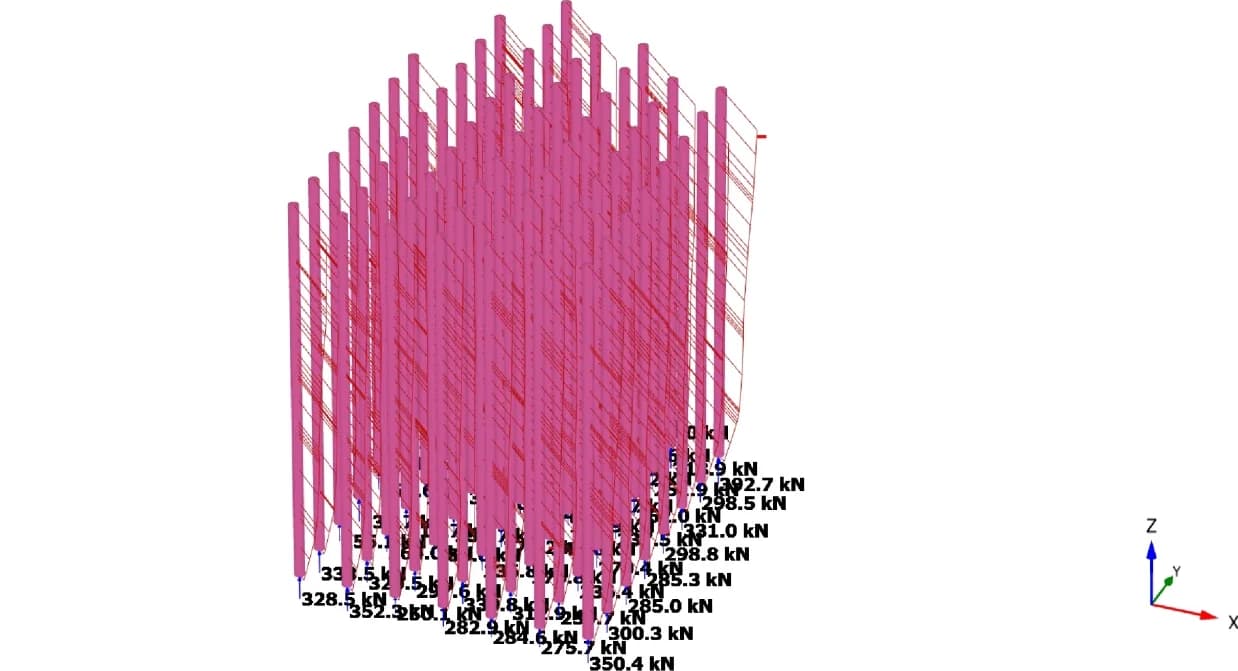
- Pile groups, where piles interact through the soil and the group stiffness and damping depend on spacing and frequency, not just pile count.
- Piled rafts, where load shares between raft bearing and pile shafts and the split shifts with load level.
- Embedded basements, where sidewall contact adds stiffness and damping that surface-footing formulas miss.
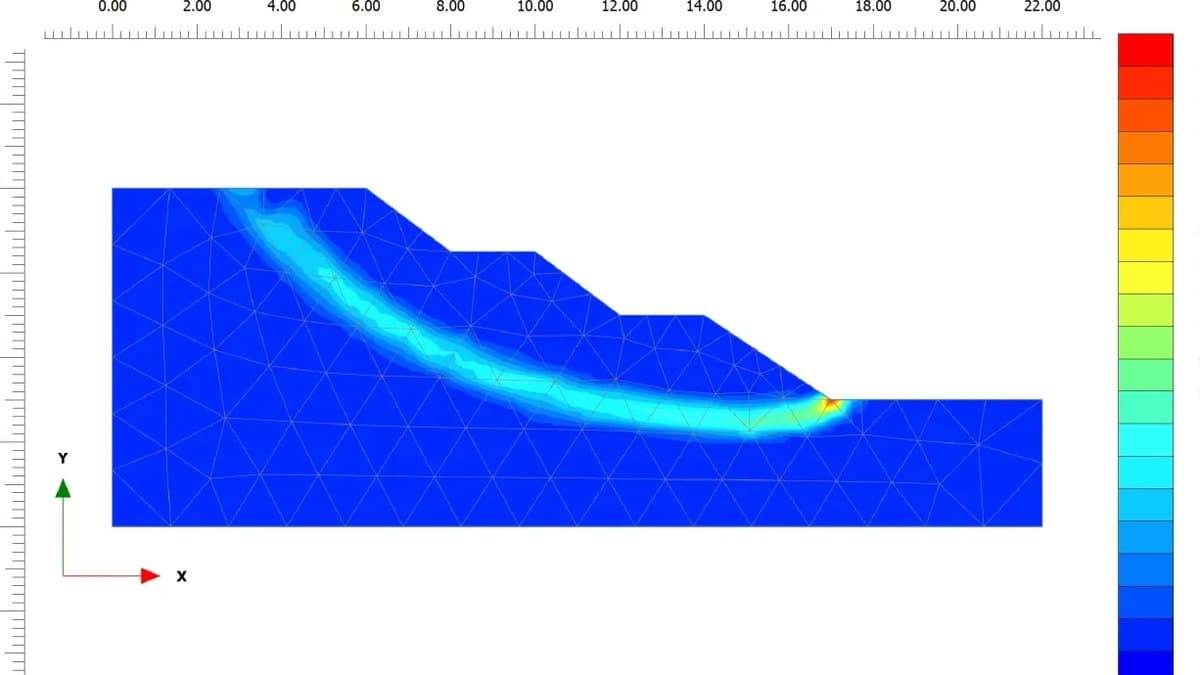
- Nonlinear response, where stiffness degrades with strain, gaps open, or layers risk liquefaction under seismic shaking.
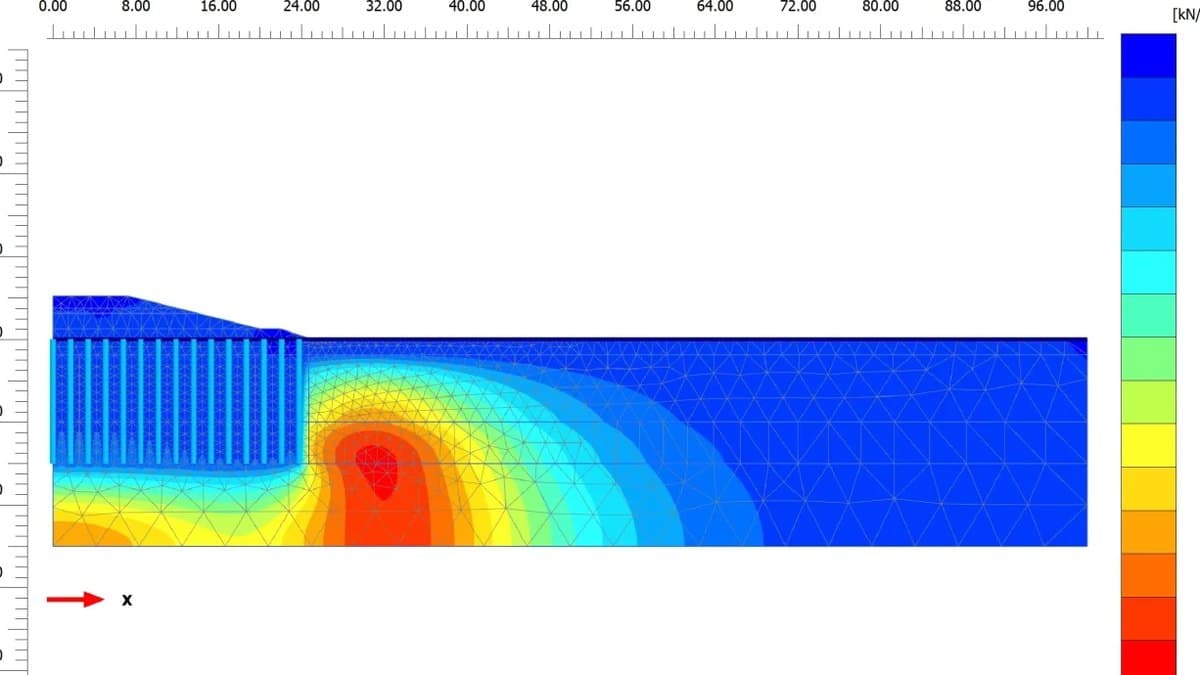
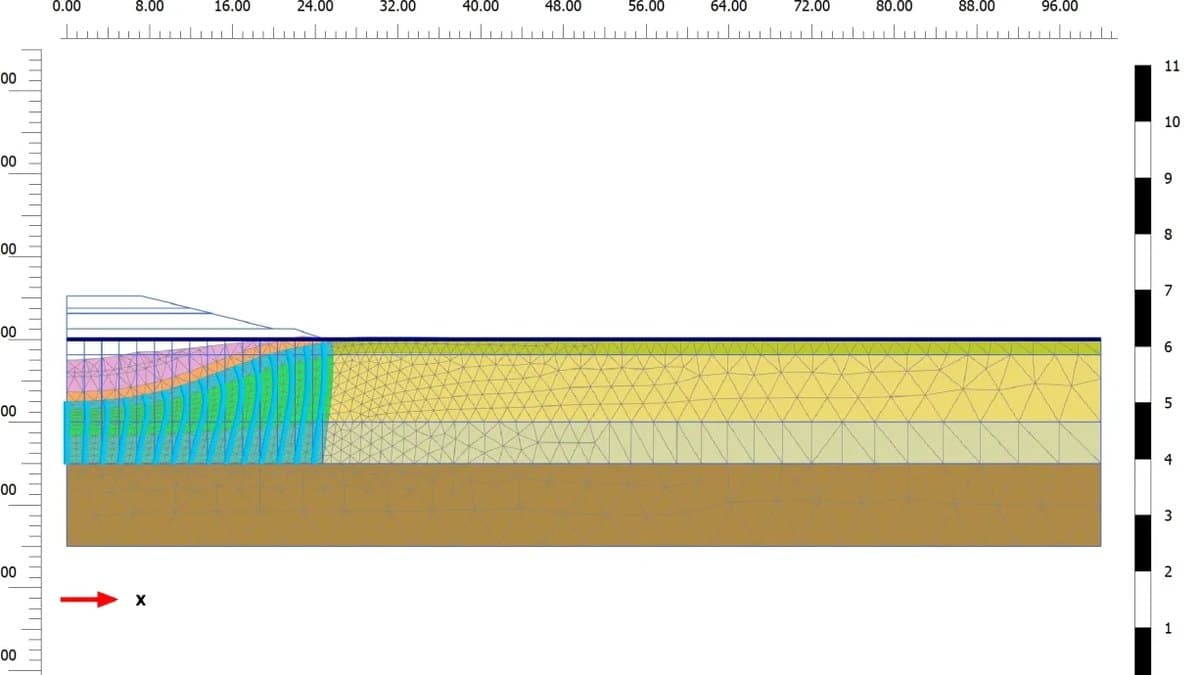
A full finite element soil model handles these directly. The soil is modelled as a continuum with a constitutive law that tracks small-strain stiffness and its degradation, absorbing boundaries let outgoing waves leave the mesh so radiation damping is computed rather than assumed, and the foundation geometry is represented as built. The output can still be delivered to the structural team as stiffness and damping values, now back-figured from a model that has earned them.
Treated properly, stiffness and damping are first-class design inputs, not afterthoughts pulled from a table. Estimate them consistently with the strain level and frequency of the problem, test the structure's sensitivity across a realistic range, and move to a continuum model once interaction effects start doing real work.
The tool for this

Finite-element analysis for soil and rock.
Model deep excavations, slopes, tunnels and foundations in 2D and 3D, with staged construction, consolidation and dynamic analysis.
FAQs
What is foundation stiffness?
The ratio of applied load to resulting deformation. A rigid foundation has six stiffness components, covering vertical, horizontal, rocking and torsional motion. Each depends on the foundation's size, shape and embedment, and on the modulus of the surrounding soil, which is why stiffness is a property of the soil-foundation system rather than of the footing alone.
What is the difference between material damping and radiation damping?
Material damping is hysteresis within the soil itself, typically a few percent at small strains and growing with strain amplitude. Radiation damping is geometric: vibration energy carried away by stress waves spreading into the ground. On deep uniform deposits radiation damping usually dominates for translational motion, but it depends strongly on layering and frequency, and rocking modes radiate far less.
Why is dynamic stiffness different from static stiffness?
Under vibration the soil's inertia participates and the resistance varies with excitation frequency, so the dynamic stiffness is frequency dependent. The strain level differs too: vibrations operate at very small strains, where soil is markedly stiffer than at the working strains behind a static settlement figure. The two values can differ substantially for the same foundation.
When should a full finite element soil model replace spring constants?
When the assumptions behind the springs fail: strongly layered profiles, pile groups with frequency-dependent interaction, piled rafts sharing load between raft and piles, embedded basements, or nonlinear and liquefiable ground under seismic loading. A continuum model computes stiffness, damping and interaction directly, and its results can still be handed over as calibrated spring and dashpot values.