




A concrete slab almost never fails by collapsing. It fails by sagging: cracked partitions, doors that stop closing, a floor that feels springy, ponding on a roof. Deflection is a serviceability problem — and on most slab designs it, not strength, is the governing check.
That makes deflection analysis unforgiving of shortcuts. The elastic value from a quick model is only the starting point; cracking and long-term creep multiply it several times over. This guide covers why deflection governs, the limits codes impose, what actually drives the number, and how it is computed properly.
Why deflection governs slab design
- Serviceability, not strength. A slab passing every ultimate check can still deflect enough to crack brittle partitions built on it. The damage threshold for finishes arrives long before any structural distress.
- Codes limit it explicitly. Typical limits run around span/250 for total long-term deflection and span/350 to span/500 for the deflection occurring after partitions are installed, with each code and project specification setting its own values.
- It compounds. A slab that deflects visibly invites ponding (flat roofs), vibration complaints, and out-of-level floors that cost real money to correct after the fact.
What drives the number
| Factor | Effect on deflection |
|---|---|
| Span length | Grows roughly with the fourth power of span — doubling span is ~16× the deflection |
| Slab thickness | Stiffness grows with the cube of depth — the strongest lever the designer has |
| Cracking | A cracked section can be several times more flexible than the gross section |
| Creep | Sustained load deflection grows for years; long-term values are typically 2–3× elastic |
| Shrinkage | Adds curvature in asymmetrically reinforced slabs |
| Load history | When props are struck and when partitions go up decides how much deflection they experience |
The last row is the one hand methods handle worst: what matters to a partition is not total deflection but the share that happens after it is built.
How slab deflection is analysed
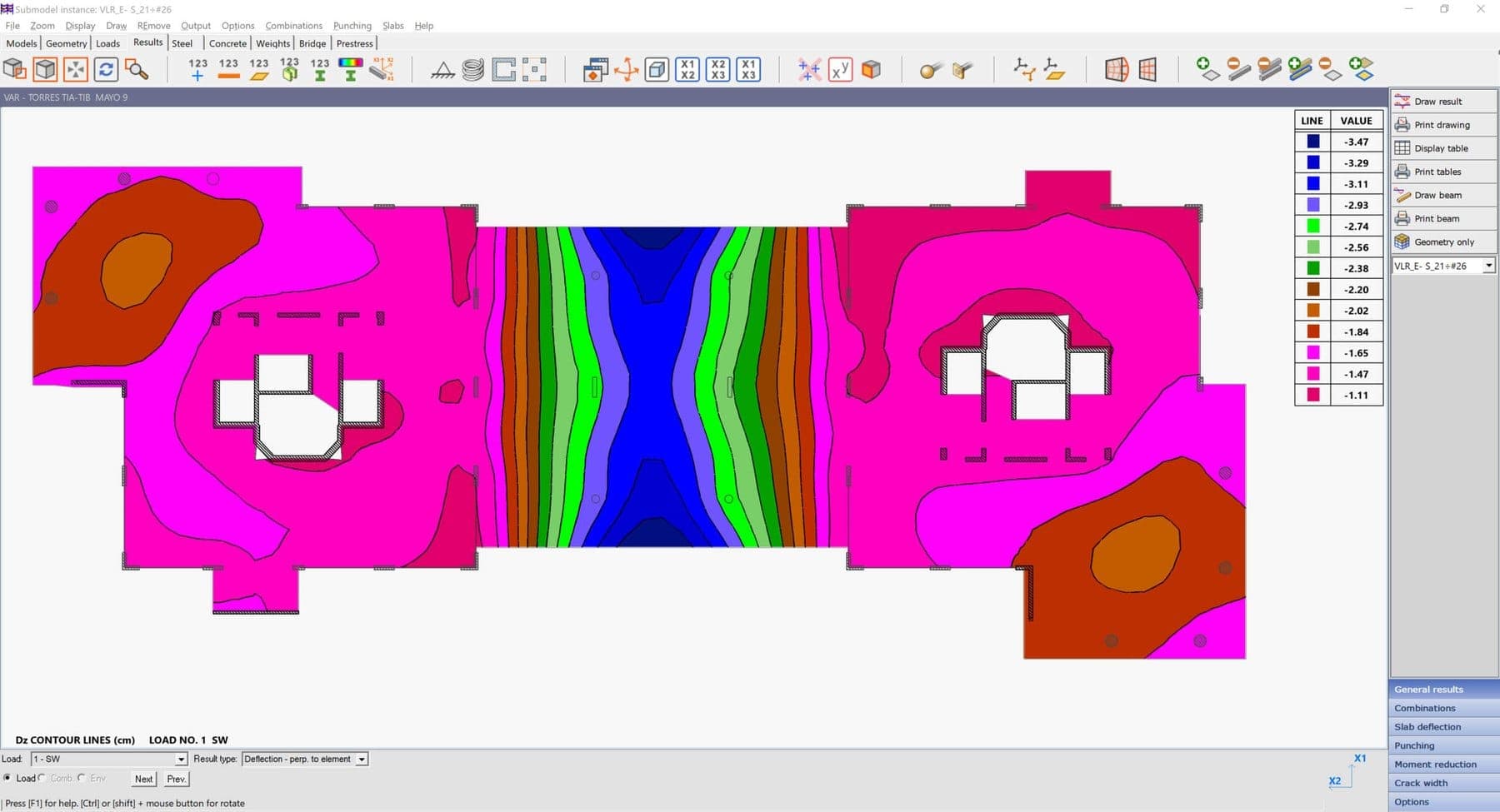
For regular, rectangular panels, span-to-depth ratios and coefficient methods give a first sizing. They stop being trustworthy as soon as the slab is irregular: openings, band beams, transfer zones, uneven column grids, or point loads.
Finite element analysis models the slab as it is — real geometry, real supports, real load pattern — and returns the full deflected shape. A proper serviceability run accounts for:
- Cracked-section behaviour, reducing stiffness where the moment exceeds the cracking moment rather than everywhere at once.
- Creep and shrinkage, through an effective long-term modulus or explicit time-dependent analysis.
- Load staging, separating deflection before and after finishes are installed so the right value is checked against the right limit.
Keeping deflection in bounds
- Depth first. Stiffness scales with the cube of thickness; an extra 25 mm of slab depth outperforms most other measures.
- Support layout. Shorter spans, well-placed columns and band beams cut the span term that deflection grows on so steeply.
- Reinforcement and prestress. Extra bottom steel raises the cracked stiffness; post-tensioning balances load directly and is the standard fix for long spans.
- Construction discipline. Late striking of props and delayed loading of young concrete keep early creep from locking in a permanent sag.
- Camber where appropriate. Casting a slab high can offset predicted long-term deflection — provided the prediction is honest.
The tool for this

Structural analysis and design for every material.
Analyse and code-check steel, concrete and cold-formed structures — frames, slabs, shear walls and bridges — in one model.
FAQs
What is the allowable deflection for a concrete slab?
Commonly around span/250 for total long-term deflection, and span/350 to span/500 for the deflection occurring after brittle partitions or finishes are installed. The governing values come from the applicable design code and the project specification.
Why is the real deflection larger than the calculated elastic value?
Two effects: cracking, which cuts the section's stiffness once the cracking moment is exceeded, and creep, which makes concrete keep deforming under sustained load for years. Together they typically put the long-term in-service deflection at two to three times the short-term elastic value.
When is finite element analysis needed for slab deflection?
When the slab is anything but a regular rectangular panel: irregular column grids, openings, band beams, transfer slabs, heavy point loads or long spans. FE analysis computes the actual deflected shape with cracked-section and long-term effects instead of relying on coefficients derived for idealised panels.
Does adding reinforcement reduce slab deflection?
It helps, but less than depth does. Extra tension steel raises the cracked section's stiffness and controls crack widths, while slab thickness enters the stiffness with a cube power. For long spans, post-tensioning is usually the effective route because it counteracts the load directly.