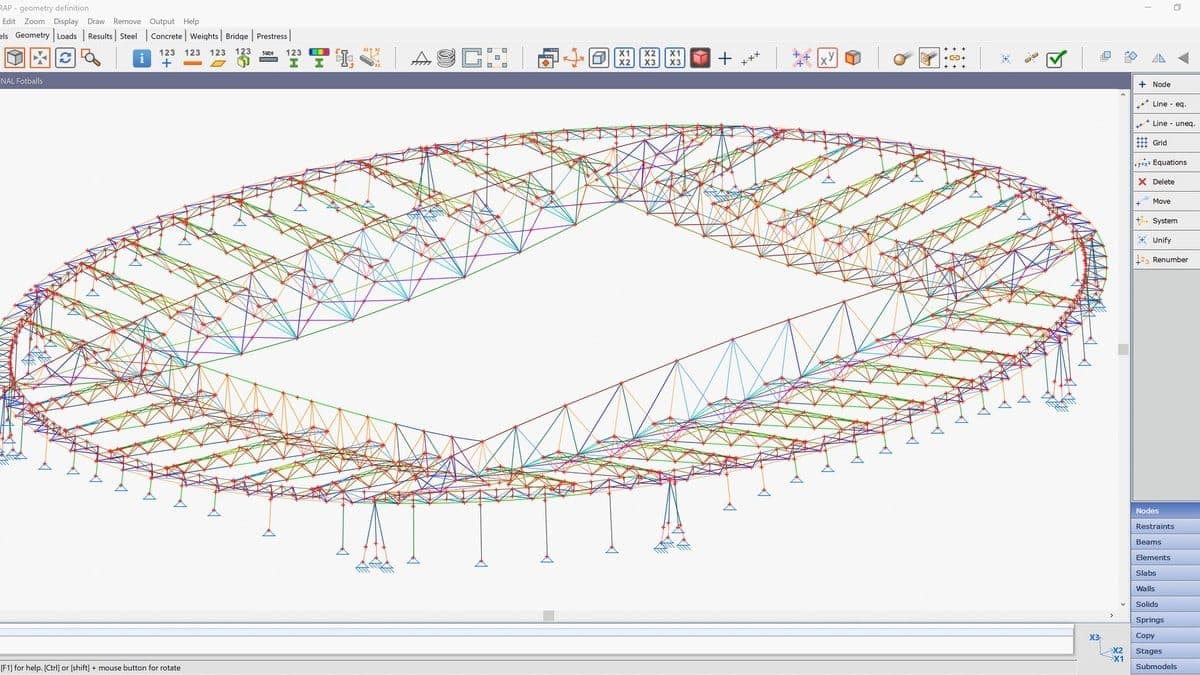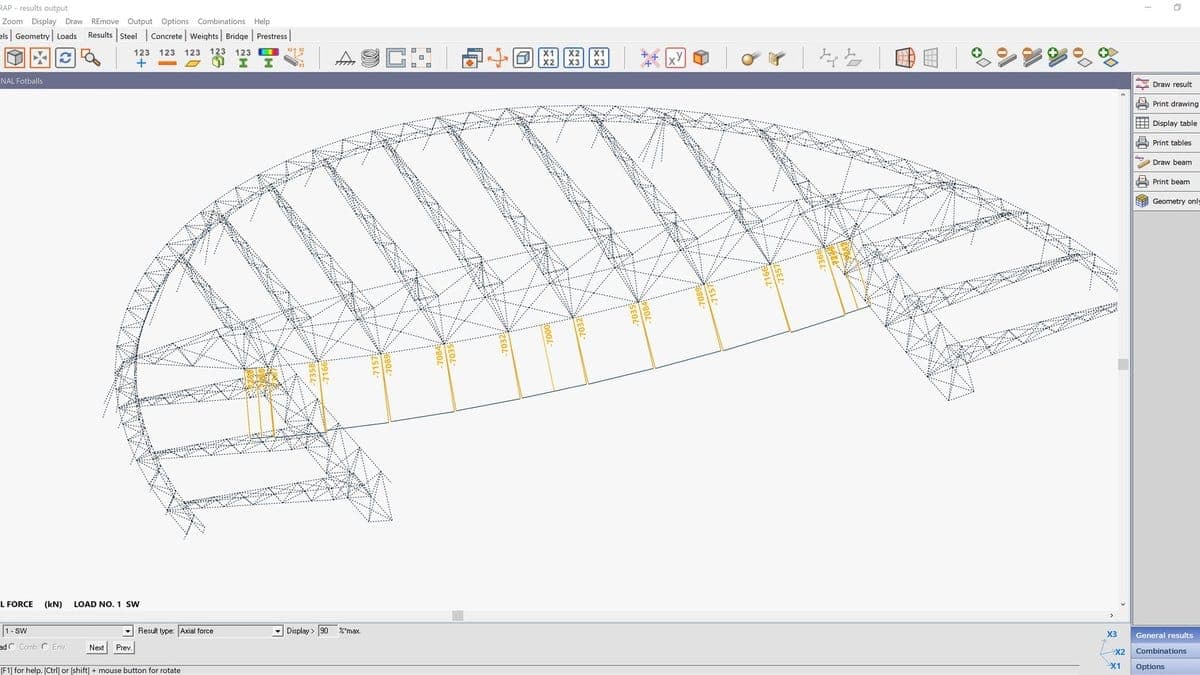





A truss is the most efficient way steel spans a long distance: it replaces a solid beam with a triangulated frame, so material sits only where force flows. Instead of bending, the loads resolve into axial push and pull along the members — and steel is at its best carrying pure tension and compression.
That efficiency is why trusses roof stadiums, carry bridges and frame industrial buildings at spans a rolled beam could never touch economically. This guide covers how trusses work, the main types, and what their analysis and design actually involve.
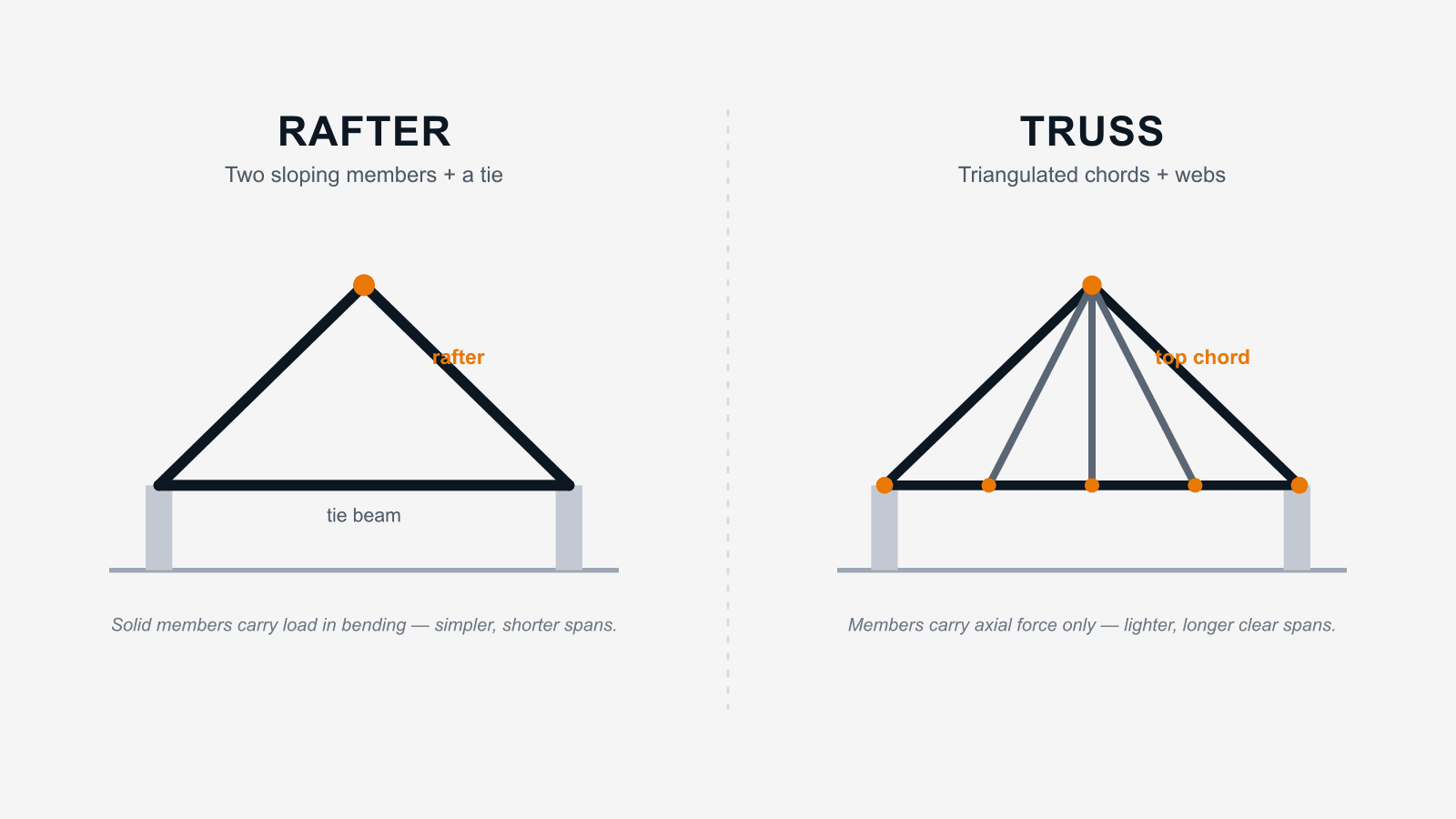
How a truss carries load
The triangle is the only polygon that cannot change shape without changing the length of a side. Build a frame of triangles, load it at the joints, and every member carries close to pure axial force:
- Chords — the top and bottom members act like the flanges of a deep beam: the top chord takes compression, the bottom chord tension (for gravity load on a simply supported truss).
- Web members — diagonals and verticals carry the shear between the chords, alternating between tension and compression along the span.
- Depth is the lever arm. A deeper truss means smaller chord forces for the same moment — the direct trade between structural depth and steel tonnage.
The classical idealisation assumes pinned joints and loads applied at nodes. Real trusses have continuous chords and stiff gussets, so members also see secondary bending — small in a well-proportioned truss, but not zero.
The truss types and where each fits
| Type | Web pattern | Typical use |
|---|---|---|
| Pratt | Diagonals lean toward midspan — in tension under gravity | Bridges, long-span floors; efficient because the long members are tension ones |
| Howe | Diagonals lean away from midspan — in compression | Historically timber; steel versions where load reversal matters |
| Warren | Alternating equal-angle diagonals, few verticals | Clean, economical for uniform loads; the default modern building truss |
| Fink / fan | Subdivided rafters | Pitched roofs of moderate span |
| Vierendeel | No diagonals — rigid joints carry shear as bending | Where openings must pass through the structural depth |
The Vierendeel is the exception that proves the rule: without triangles its members carry heavy bending, so it spends much more steel for the same span and is chosen only when a clear rectangular opening is worth that price.
Analysing and designing a truss
Hand statics — method of joints, method of sections — solves a determinate truss quickly and remains the right first pass. The full design needs more:
- Load cases and reversal. Wind uplift on a light roof truss can flip every member force; the diagonal sized for tension must then survive as a strut.
- Buckling checks. Each compression member is verified against its in-plane and out-of-plane effective lengths, tied to the real bracing layout.
- Deflection. Long-span trusses are commonly camber-fabricated to offset computed dead-load deflection.
- Secondary effects. Continuous chords, joint eccentricities and purlin loads between nodes add bending that a pin-jointed idealisation misses — a frame analysis of the real geometry picks these up.

The connections make or break it
Every node concentrates several member forces into one gusset or welded joint. The checks — bolt shear, bearing, block shear, gusset buckling, weld strength — each read a different failure path, and the governing one is rarely obvious from inspection. Modelling the actual node geometry, rather than assuming the idealised pin, is what closes the gap between the frame analysis and the fabricated steel.
The tool for this

Structural analysis and design for every material.
Analyse and code-check steel, concrete and cold-formed structures — frames, slabs, shear walls and bridges — in one model.
FAQs
Why are trusses more efficient than solid beams for long spans?
A beam carries load in bending, which stresses only its extreme fibres fully; the web material near the neutral axis is barely working. A truss puts its material at the top and bottom (the chords) and carries shear through light diagonals, so nearly every member works close to its full axial capacity.
Which truss type is best?
For uniform gravity loading, Warren and Pratt configurations are the usual economic answers — Pratt keeps its long diagonals in tension, Warren minimises member count. The right choice depends on span, loading (including reversal), depth available, and fabrication preferences.
Do truss members really carry only axial force?
Approximately. The pin-jointed model is accurate enough for member sizing when loads land at nodes and members are slender. Continuous chords, stiff gussets, eccentric joints and loads between nodes all add secondary bending, which a frame analysis of the real geometry captures.
What usually governs a steel truss design?
Compression buckling and the connections. Compression chords and struts are limited by effective length rather than cross-section area, and node connections — gussets, bolts, welds — introduce multiple failure paths that must each be checked. Deflection and load reversal under wind uplift follow close behind.