





Composite beams combine two or more distinct materials, bonded together to act as a single structural element, to achieve strength, stiffness, and durability that neither material delivers alone. This article covers the principles, design considerations, advantages, and applications of composite beams in modern construction.
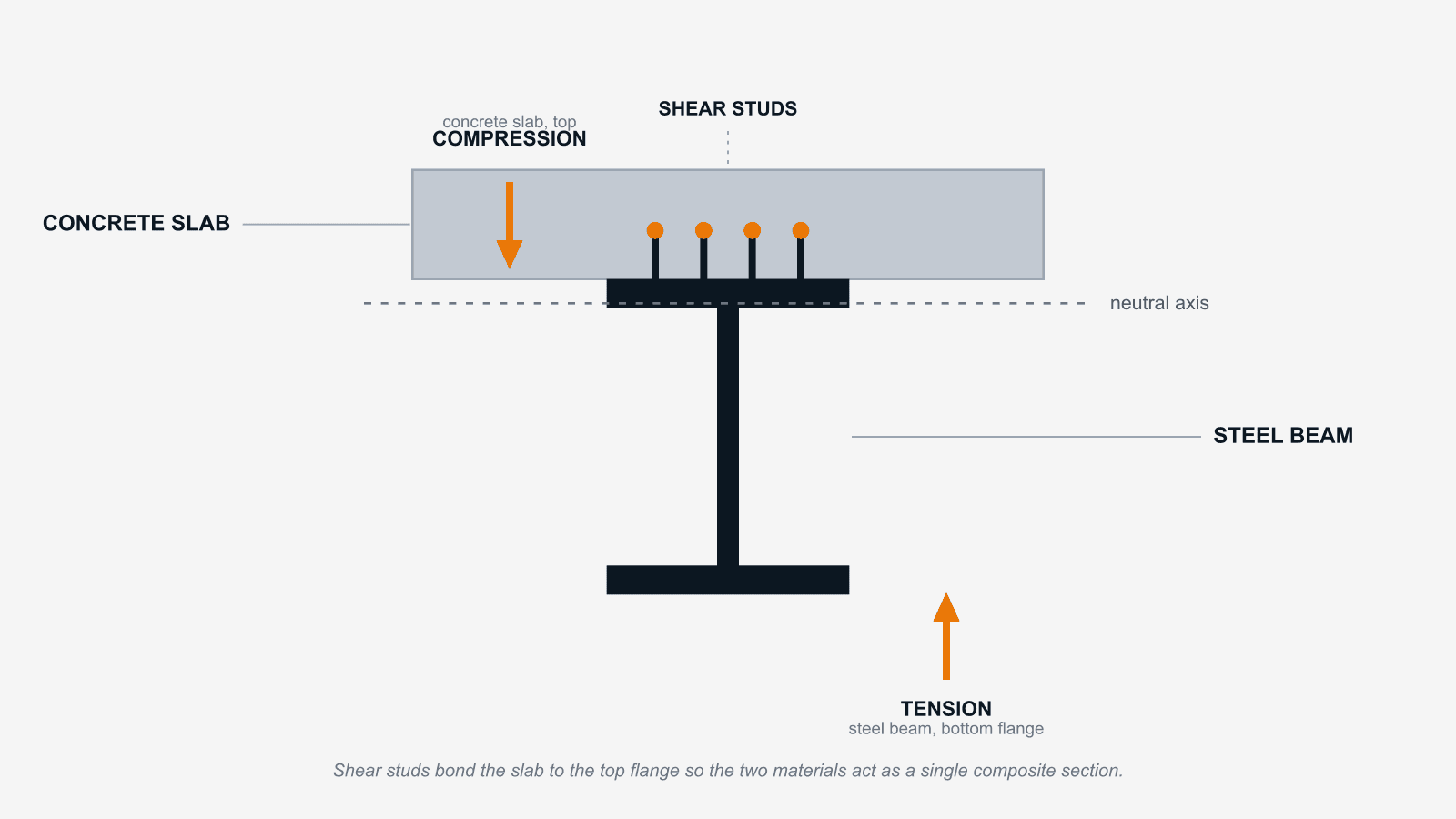
Understanding composite beams
These structural elements consist of two or more distinct materials bonded together to form a single structural element. Typically, these materials include steel, concrete, timber, and fiber-reinforced polymers (FRPs). By combining materials with complementary properties, the system leverages the strengths of each component while offsetting their respective weaknesses.
Primary components of composite beams
- Steel — known for its strength and ductility, steel provides the structural framework and load-bearing capacity in composite beams. Steel elements, such as I-beams or channels, serve as the primary support structure.
- Concrete — commonly used as the composite slab or flange in composite beams. It provides additional strength, stiffness, and fire resistance while enhancing the structural performance of the beam.
- Connectors — mechanical connectors, such as shear studs or welded connectors, bond the steel and concrete components together, ensuring effective load transfer and composite action.
Design considerations for composite beams
The design of composite beams involves several key considerations to ensure structural integrity:
- Load distribution — engineers analyze anticipated loads, including dead loads (the weight of the structure itself) and live loads (occupants, furniture, equipment). Composite beams are designed to distribute these loads efficiently, minimizing deflection and stress concentrations.
- Composite action — effective integration of steel and concrete components is essential to achieve composite action, where the materials work together to resist bending and shear forces. Proper detailing of connectors and composite slab reinforcement is required to facilitate load transfer.
- Deflection and serviceability — composite beams must meet serviceability requirements, including deflection limits and vibration control. Engineers use analytical methods and computational tools to predict and mitigate deflection issues.
- Fire resistance — composite beams are designed to maintain structural integrity during a fire event. Fire-resistant coatings, concrete cover, and thermal insulation measures protect the underlying steel structure.
- Durability and maintenance — composite beams are subject to environmental factors such as moisture, corrosion, and chemical exposure. Corrosion protection measures, such as galvanization or epoxy coatings, reduce maintenance requirements over the beam's service life.
Advantages of composite beams
Composite beams vs. non-composite alternatives
| Feature | Composite Beams | Non-Composite Alternatives |
|---|---|---|
| Strength-to-weight ratio | Higher — achieves strength while minimizing structural weight | Lower — typically heavier to achieve the same strength |
| Deflection and stiffness | Enhanced by composite action between steel and concrete | Standard — more susceptible to bending and shear without composite action |
| Span capability | Longer spans, suited to open-plan interiors | Shorter spans, often need more frequent support columns |
| Load-carrying capacity | Higher, from the interaction of the two materials | Standard |
| Material efficiency | Optimized — materials are used closer to their full structural potential | Individual materials may not be fully utilized |
- High strength-to-weight ratio — combining steel and concrete achieves strength and stiffness while minimizing structural weight, supporting longer spans and heavier loads with less material.
- Structural performance — composite action between steel and concrete improves resistance to bending, shear, and torsional forces, reducing deflection compared to non-composite alternatives.
- Design flexibility — composite beams give architects and engineers room to configure structural layouts and architectural forms by tailoring material properties.
- Life-cycle cost — while initial construction costs can be higher than traditional methods, reduced material consumption, faster construction, and lower maintenance can offset that cost over the life of the structure.
- Material efficiency — composite beams optimize material usage and reduce waste, aligning with sustainable construction practices.
Applications of composite beams
Composite beams are used across several construction sectors:
- Building construction — supporting floor slabs, roofs, and mezzanine levels in commercial, residential, and institutional buildings, where their strength-to-weight ratio helps achieve long spans and open-plan interiors.
- Bridge construction — supporting roadway decks, pedestrian walkways, and transportation infrastructure, particularly in rehabilitation and replacement projects.
- Industrial facilities — manufacturing plants and warehouses use composite beams to accommodate heavy machinery, storage racks, and dynamic loads.
- Infrastructure projects — railway stations, airport terminals, and sports arenas use composite beams to handle dynamic loads, seismic forces, and environmental exposure.
- Marine and offshore structures — offshore platforms, docks, and seawalls use composite beams for their corrosion resistance and durability in marine environments.
Checking composite beam design to code
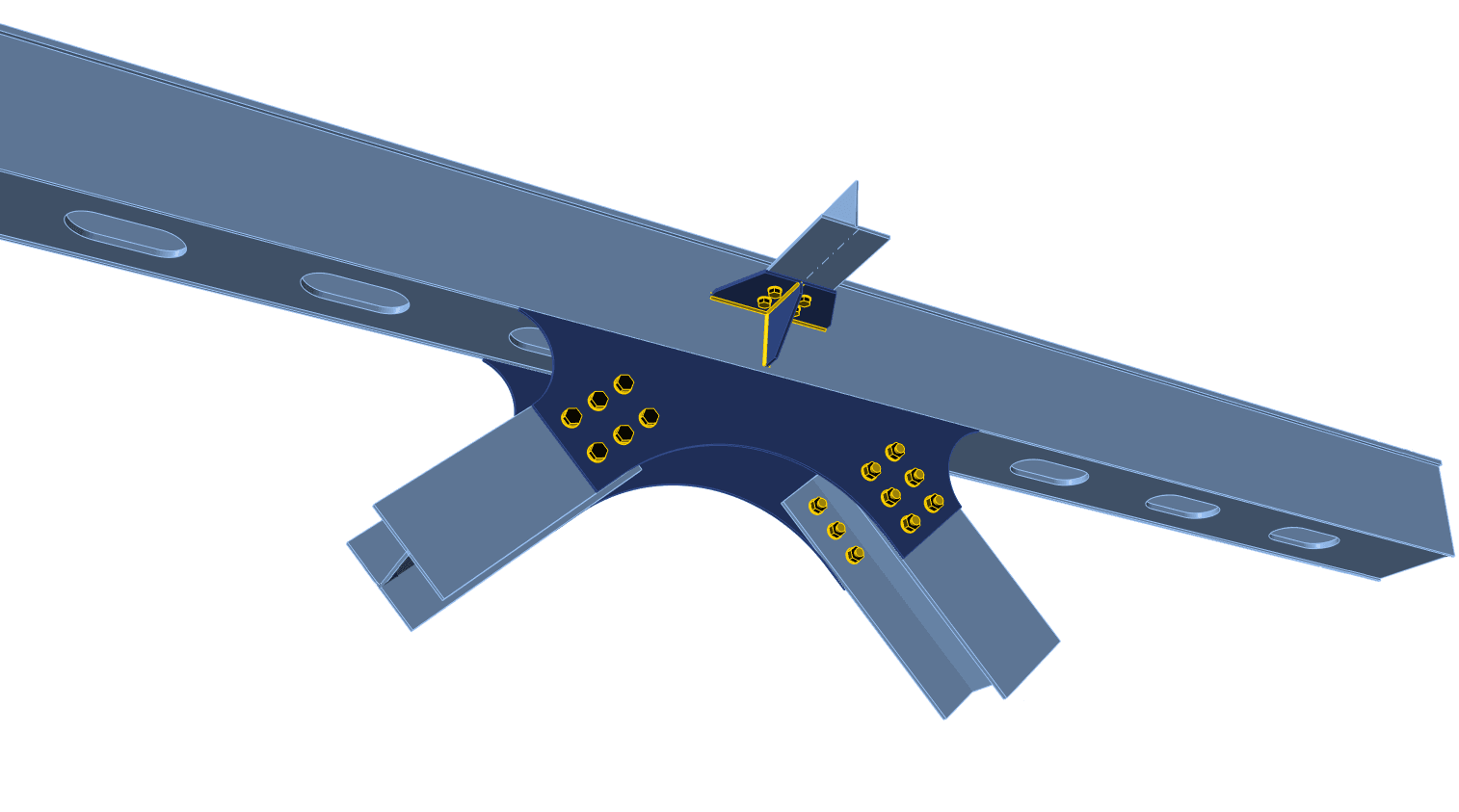
Composite action, shear-connector spacing, deflection limits, and fire-resistance detailing all have to be verified together — and the connections at each end of the beam still need their own code check for the shear and moment they carry into the supporting frame.
The tool for this

Code-check any steel connection to AISC & Eurocode.
Model welded, bolted and moment connections on the real geometry with CBFEM — clear pass/fail results and a full report in minutes.
FAQs
What are composite beams?
Composite beams are structural elements consisting of two or more distinct materials, typically steel and concrete, bonded together to act as a single unit.
What are the primary components of a composite beam?
The main components include a steel beam (frame), a concrete slab (flange), and mechanical connectors (shear studs) to bond them together.
What is the function of shear connectors?
Connectors, such as shear studs, bond the steel and concrete components to ensure effective load transfer and composite action.
What are the advantages of using composite beams?
A higher strength-to-weight ratio, reduced deflection, enhanced structural stiffness, and design flexibility compared to non-composite materials.
Are composite beams fire resistant?
They are designed to withstand fire exposure using fire-resistant coatings, concrete cover, and thermal insulation to protect the steel.
Where are composite beams commonly used?
In commercial buildings, bridge construction, industrial facilities, and infrastructure projects like railway stations.
How do composite beams support sustainable construction?
They optimize material usage and minimize waste, aligning with resource-efficient design principles.


