





Steel connection design carries an outsized share of the risk in a structural project. A joint that's undersized fails outright, and one that's oversized wastes steel and fabrication budget without anyone noticing until the invoice arrives. Getting it right on paper, by hand, for anything beyond a standard bolted shear tab, is slow and hard to verify.
IDEA StatiCa Connection was built for that gap. It models a connection's real geometry — every plate, bolt and weld — and runs a full code-check against international steel design standards, returning a clear pass/fail result along with the stress distribution that explains it.

Why lookup tables run out on complex joints
Standard connection tables and simplified spring models cover the common cases well — a straightforward shear tab, a textbook moment connection — but break down on anything irregular: skewed members, mixed cross-sections, unusual bracing angles, or a joint carrying combined axial, shear and moment at once. Those are exactly the connections that take the longest to verify by hand, and the ones most likely to end up over-designed purely to stay on the safe side, because nobody has time to check every alternative.
How CBFEM models the actual connection
IDEA StatiCa's core method — the Component-Based Finite Element Method (CBFEM) — replaces the lookup table with a true finite-element model of the joint itself. Every plate is meshed, and every bolt and weld is modelled explicitly with its own stiffness and capacity, so the software solves for how load actually flows through the connection instead of assuming it.
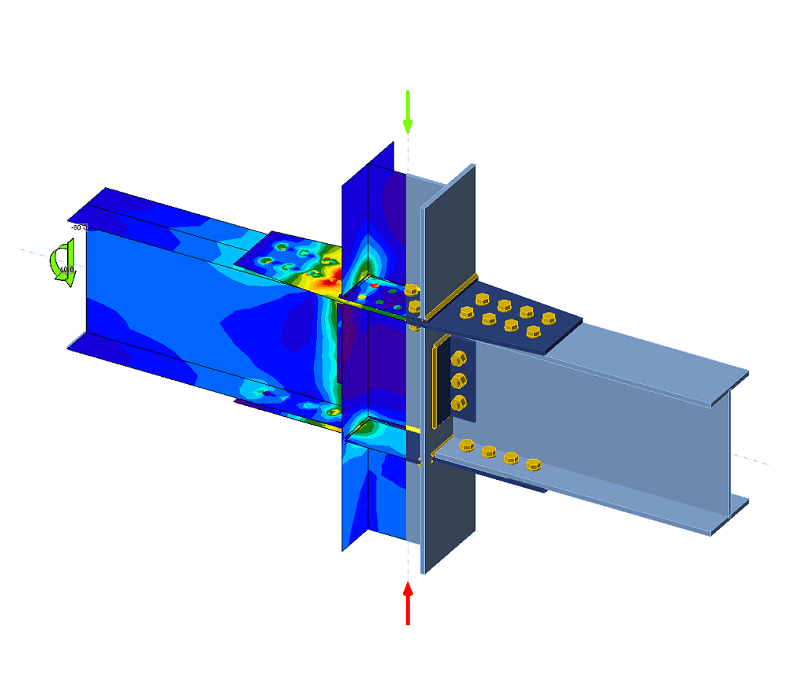
That visual output is what makes the method useful day to day, not only accurate. A colour-mapped utilization plot shows exactly where a connection is working hardest, so a design decision — add a stiffener, thicken a plate, shift a bolt row — is based on where the stress actually concentrates rather than an assumption carried over from the last project.
What gets checked in every connection
A single model run covers overall stress and strain, buckling, stiffness classification, design resistance, and seismic capacity design together — not as separate hand calculations run in isolation and then reconciled at the end. That matters most on connections carrying combined loading, where the governing check is rarely the one an engineer would have picked first.
Connection types and design codes supported
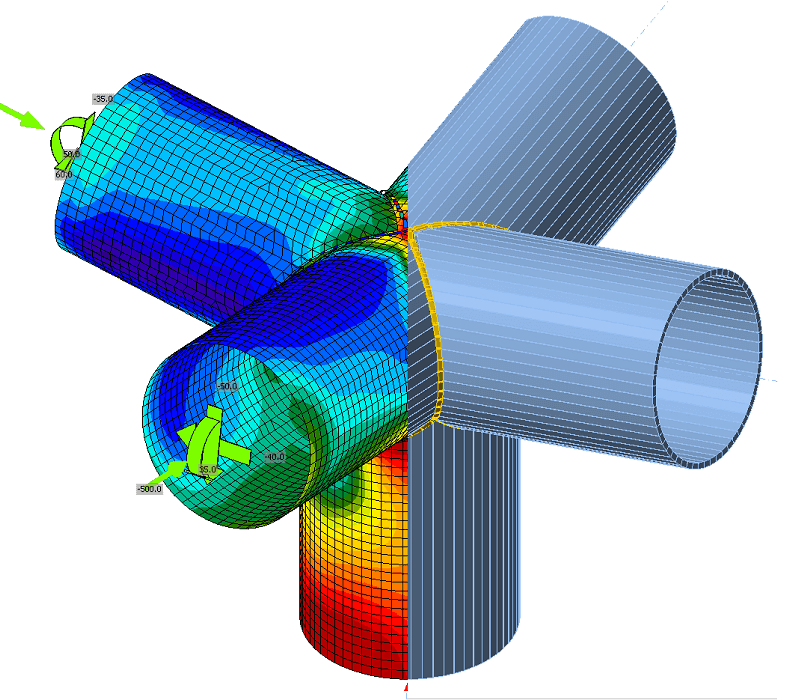
The same modelling approach covers bolted and welded connections, column base plates and footings, circular and rectangular hollow-section (CHS/HSS) joints, and steel-to-timber connections — checked against AISC 360, Eurocode (EN 1993), IS 800, BS 5950 and AS 4100, among others.
From model to signed-off report
The output isn't only a pass/fail flag. IDEA StatiCa generates a full engineering report — formulas, connection sketches, load cases and results — in a format built for a checker's sign-off, so the detailing work a firm might otherwise send out can stay in-house.
Connections modelled directly from a project's real geometry, checked against the applicable code, with a report ready to hand to a checker: that's the difference between a design defended on paper and one an engineer can actually stand behind. RAM CADDSYS is the authorized IDEA StatiCa reseller and certified training partner across India, Singapore and the wider Asia-Pacific region, with local support alongside the license.
The tool for this

Code-check any steel connection to AISC & Eurocode.
Model welded, bolted and moment connections on the real geometry with CBFEM — clear pass/fail results and a full report in minutes.
FAQs
What is IDEA StatiCa Connection used for?
Modelling and code-checking steel connections — bolted, welded, base plates, footings, CHS/HSS and steel-to-timber joints — on their real geometry rather than matching them to a simplified template.
What is CBFEM?
The Component-Based Finite Element Method — it meshes every plate and models bolts, welds and contact explicitly, replacing lookup tables and rules of thumb with a true finite-element model of the connection.
Which design codes does IDEA StatiCa support?
AISC 360, Eurocode (EN 1993), IS 800, BS 5950 and AS 4100, among others, so the same connection model can be checked against whichever code a project requires.
How much time does IDEA StatiCa save on connection design?
Accurate connection design in IDEA StatiCa can cut design time substantially compared with manual calculation — reported at roughly 75% for straightforward connections and up to 85% for demanding ones.
Can IDEA StatiCa import connections from other structural software?
Yes — connections can be imported directly from common CAD and analysis packages such as Tekla, STAAD, ETABS and Robot, so the joint geometry doesn't need to be rebuilt from scratch.
Is the CBFEM method validated against physical testing?
Yes — CBFEM is benchmarked against laboratory testing and peer-reviewed research, which is part of why it holds up on connection geometries that standard lookup tables don't cover well.


