





Prestressed concrete is used in the construction of beams, floors, and other structural elements. It is called "prestressed" because the concrete is placed under compression before being subjected to the tensile forces it will experience in service.
This is done using high-strength steel strands or cables, called prestressing tendons, that are anchored to the ends of the structural element and then tightened. The tension in the tendons produces a compressive force in the concrete that counteracts the tensile forces the concrete will be subjected to when in use. The result is a more efficient, stronger structural element that can span longer distances and support more load than a non-prestressed concrete element of the same size.
Advantages of this material
- Greater strength. Prestressing allows the use of high-strength concrete and high-strength steel tendons, resulting in a stronger and more durable structure.
- Increased span length. Because prestressed concrete is under compression, it can span longer distances than non-prestressed concrete of the same size, making it well suited to long-span structures such as bridges.
- Reduced deflection. Prestressed concrete deflects less than non-prestressed concrete, so it is less prone to sagging or bending under load.
- Improved fatigue resistance. Prestressed concrete withstands repeated loading without failing, which suits structures such as bridges and parking garages.
- Increased durability. Prestressed concrete resists cracking and is less prone to corrosion damage, making it durable for structures exposed to the elements.
- Construction efficiency. Prestressed concrete elements can be prefabricated off-site, saving time and labor during construction.
How does it work?
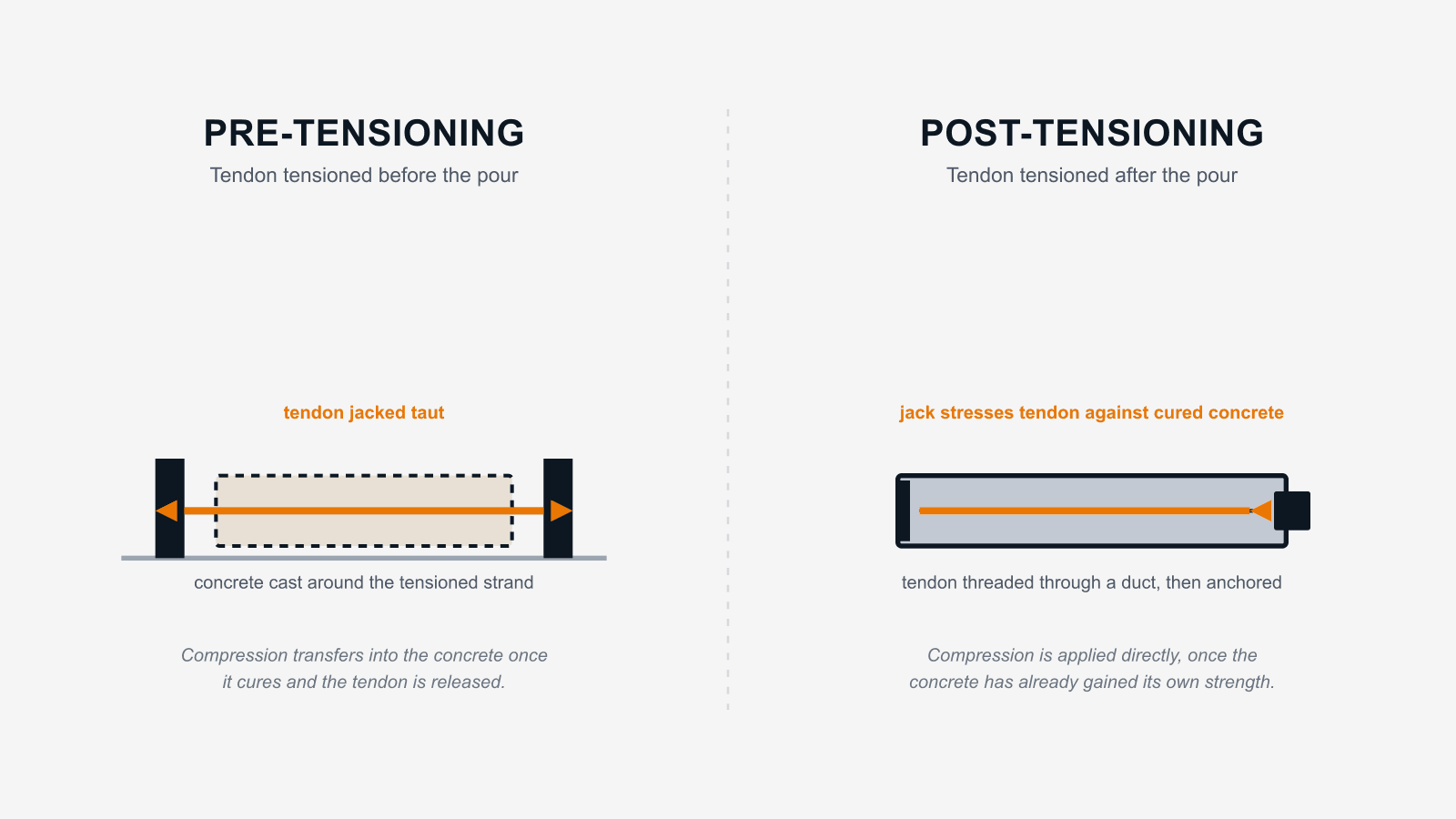
| Feature | Pre-tensioning | Post-tensioning |
|---|---|---|
| Timing | Tendons tensioned before concrete pour | Tendons tensioned after concrete cures |
| Process | Concrete poured around tightened tendons | Tendons passed through drilled holes/ducts |
| Mechanism | Released tension compresses concrete | Hydraulic jacks tighten tendons against anchors |
Prestressed concrete works by using high-strength steel tendons to place the concrete under compression before it is subjected to tensile forces. The tendons are anchored to the ends of the structural element and tightened using a hydraulic jack. The resulting tension produces a compressive force in the concrete that counteracts the tensile forces the element will experience in service.
There are two main methods for achieving this: pre-tensioning and post-tensioning.
In the pre-tensioning method, the tendons are tensioned before the concrete is poured. They are anchored to the ends of the structural element and tightened with a hydraulic jack, and the concrete is then poured around them and allowed to cure. Once cured, the tendons are released, and the resulting tension produces a compressive force in the concrete.
In the post-tensioning method, the tendons are tensioned after the concrete has been poured and cured. Holes are drilled through the concrete, the tendons are passed through and anchored to the ends of the element, and then tightened using a hydraulic jack to produce the compressive force.
How to implement prestressed concrete
- Design. A qualified engineer carries out the design of the element, accounting for the loads it will be subjected to and the required span length.
- Fabrication. The prestressing tendons and other components — anchors, stressing jacks — are fabricated to the design specifications.
- Erection. The tendons and components are installed on site per the design.
- Tensioning. The tendons are tensioned with a hydraulic jack according to the design specifications.
- Concrete placement. Concrete is placed around the tendons and allowed to cure.
- Release. In pre-tensioning, the tendons are released once the concrete has cured, producing the compressive force. In post-tensioning, the tendons remain in tension.
- Finishing. The structure's surface is finished per the design and applicable codes or standards.
Analyzing prestressed elements to code
Prestressed concrete elements need to be checked under bending, shear, and torsion across multiple loading conditions — a task where moment, stress, and deformation diagrams generated by design software help engineers verify behavior before construction.
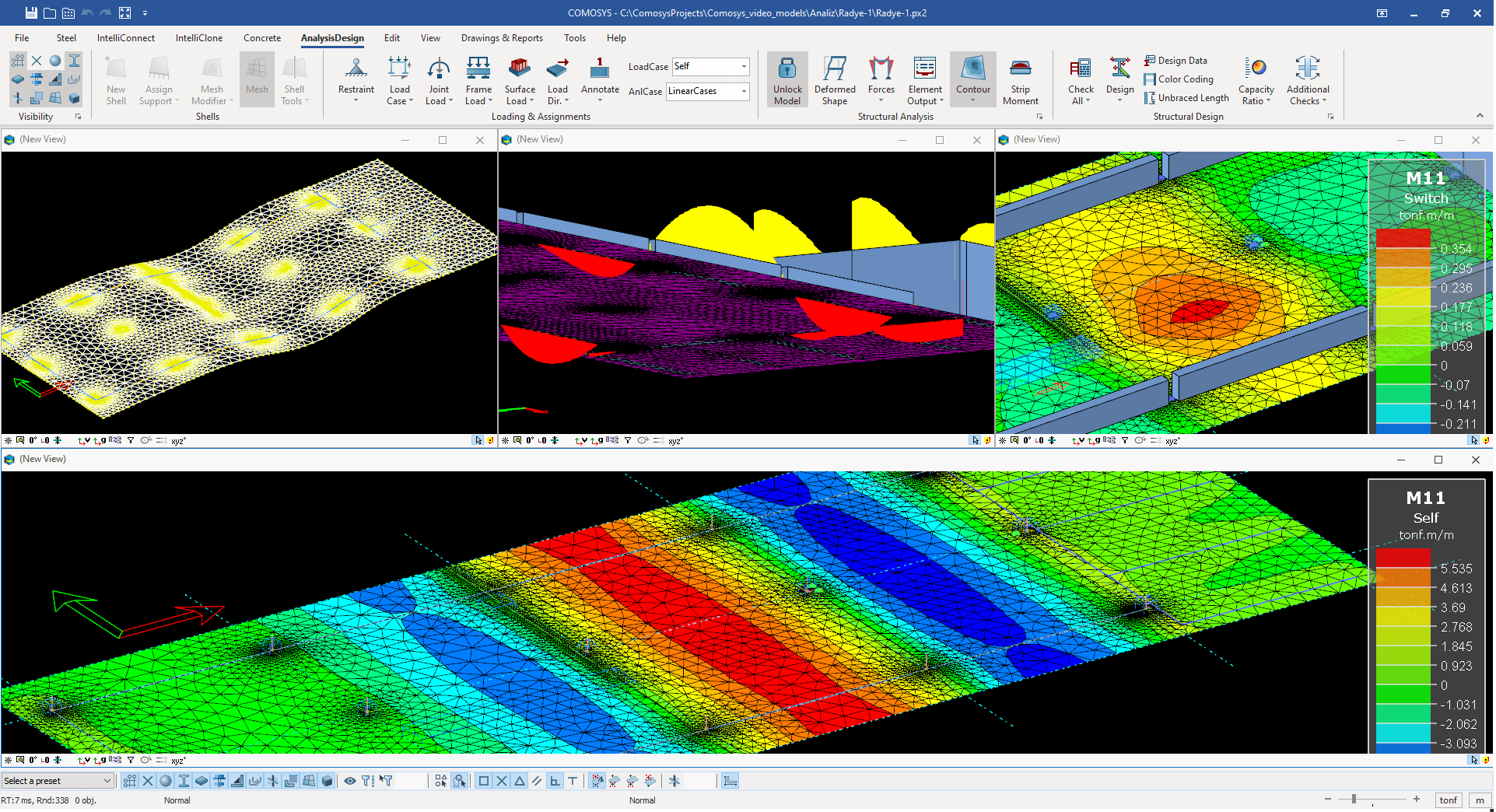
Reinforcement layout for prestressed and conventionally reinforced members — mild steel plus tendons together — needs to stay coordinated with that analysis as spans and load paths are finalized, right through to bar scheduling and drawing production.
The tool for this

Steel & concrete detailing, automated.
Generate rebar layouts, bar bending schedules and fabrication-ready drawings from a single model, consistent and code-compliant.
FAQs
What is prestressed concrete?
A structural material placed under compression using high-strength steel strands before being subjected to service loads.
Why is concrete prestressed?
To create a compressive force that counteracts the tensile forces the element will experience in use.
What are the main advantages of prestressed concrete?
Greater strength, increased span length, reduced deflection, improved fatigue resistance, and durability against cracking.
What is the difference between pre-tensioning and post-tensioning?
In pre-tensioning, tendons are tightened before the concrete is poured. In post-tensioning, tendons are tightened after the concrete has cured.
What are prestressing tendons?
High-strength steel strands or cables anchored to the ends of a structural element to apply compressive force.
Where is prestressed concrete used?
In beams, floors, bridges, parking garages, and long-span structures requiring high load support.


